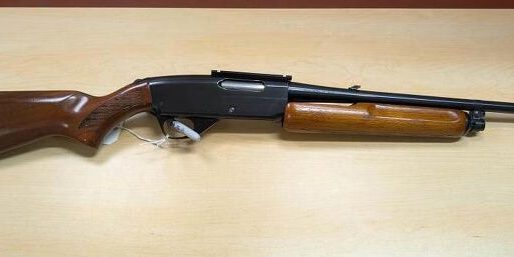
![The Savage 170 should have been a better gun and seen more success. It was just hampered by a finicky action. [scotraid/Gunbroker]](https://taskernetwork.com/wp-content/uploads/2026/06/post-32.jpg)
The world of guns is like the world of motorcycles (and I’d know, because I pay close attention to both). There are some models that look like they should be very successful; on paper, they have a lot of desirable features. But in the real world, they’re let down by some issue that prevents them from becoming an all-time great. I would put the Savage 170 pump-action rifle squarely in that category. It could have been great, it should have been great—but it wasn’t, and it’s basically forgotten.
Savage Arms in the field @ TFB:
- Fudd Friday: Seven Decades Of The Savage 110
- TFB Behind The Gun Podcast #106: Talking Shop With Savage Arms’ Beth Shimanski
- POTD: The Moose Hunt – Savage 110 Ultralite
- Fudd Friday: Savage Revel Classic Review
Day of the pump gun
The Savage 170 rifle came into the market in 1970, in the heyday of the pump-action deer rifle.
That might sound like a pretty funny idea, saying that pump-action deer guns were ever popular, but there was a time from the 1960s through the 1980s that these guns were well-liked, mostly because of the Benoit family. The Benoits were highly successful deer hunters from New England who hunted all over the northeast, as well as into Ontario, Canada. They were just normal blue-collar guys who were really, really good at tracking down big bucks in the snowy mountains. The Benoits were the first modern celebrity hunters, with patriarch Larry even making it to the cover of Sports Afield magazine in the 1970s. And the Benoits mostly used Remington pump-action rifles. The 760 had been on the market for a while at that point, and it was well-respected, even making it into FBI special operations teams.
Savage noted the success of the 760 and decided to counter with its own pump rifle, but they didn’t start from scratch. Instead, they tweaked the Model 67 design to handle rifle rounds (most were chambered in .30-30, but some were .35 Remington). I’ve never seen official confirmation, but reportedly, they turned the .410 version of the Model 67 into a rifle. I can say that I once owned a Model 77, which was basically the same thing as the Model 67, and I also owned a Savage 170 in .30-30. I had to work on both firearms more than I cared to, and both looked like the same basic design inside.
![A tang safety, flip-up rear sight and drilled-and-tapped receiver top made this a gun that fit a wide range of hunters, whether you wanted old-school iron sights or a scope, and whether you were left-handed or right-handed. [egrant/Gunbroker]](https://taskernetwork.com/wp-content/uploads/2026/06/fudd-friday-savage-170-the-pump-action-that-should-have-been-great.jpg)
Fast-shooting Fudd firepower
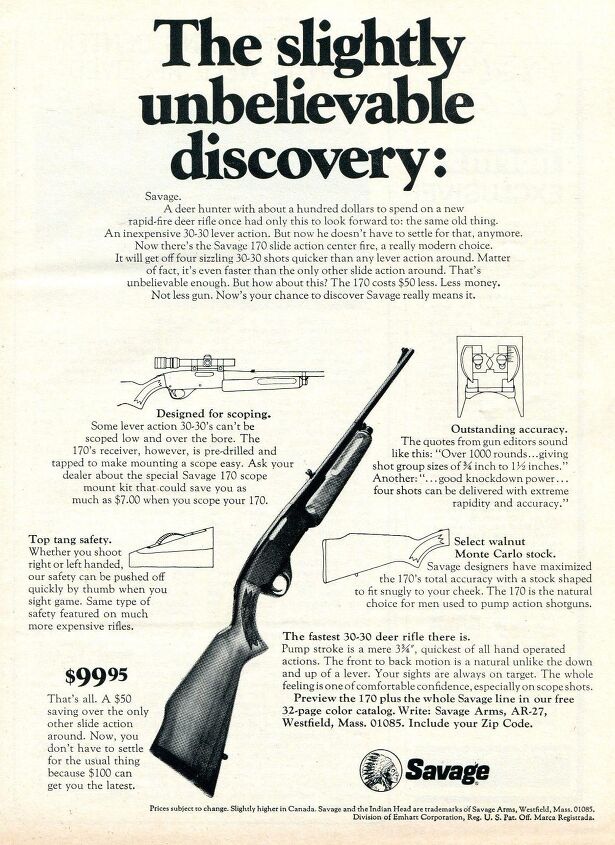
When the Savage 170 worked, it worked well. The one that I owned was much quicker to shoot than a lever gun, especially if you were used to pump-action shotguns. A tang safety made the rifle a bit easier for lefties to shoot. Iron sights came standard, but the top of the receiver was drilled and tapped to fit the same scope base as the Remington 760. I initially thought I would hunt with this rifle sans optic, but a range trip early on convinced me otherwise.
I remember reading that a gun magazine comparo of the late 1970s actually found the Savage 170 shot the best of all the .30-30s on the market at that time. Once I put a no-name scope on the 170, I found it worked well for me, especially when you considered it was the first deer rifle I’d ever owned. I can’t remember the size of the groups exactly, but the groups were easily covered by the palm of my hand at 100 yards.
That isn’t impressive by modern standards, but remember that A) It was my first time shooting a deer rifle and B) this was a 30-40 year old gun with a painfully cheap scope and the most affordable ammo that a just-married me could find. And also remember that this was a .30-30; most shooters wouldn’t poke much past 100 yards with this round anyway. I know that the first animal I ever shot with the rifle was a forkhorn buck, ambling at an angle 100 yards away. I fired three times and put two rounds cleanly through his lungs; the other round I never found, probably because I had a bad case of buck fever and the deer was on the move. Or maybe I just missed it during the butchering process. I was 100 percent self-taught and green at that point, just doing the best I could, and the Savage 170 helped me get the job done.
The problem with the 170
Unfortunately, that incident also exposed the problem with the 170, and the reason I eventually got rid of it. In a nutshell, the 170 was notorious for jamming, and the reason I didn’t dump the gun’s four rounds at the buck (three in the tube mag, one in the chamber) was that the gun jammed after my first shot (which probably missed). I wrestled with the pump furiously and managed to clear an unfired shell, then put two more at the deer.
![Here’s the full-length version of the rifle with a 22-inch barrel. [firearmsvet/Gunbroker]](https://taskernetwork.com/wp-content/uploads/2026/06/fudd-friday-savage-170-the-pump-action-that-should-have-been-great-2.jpg)
The next spring, I was in a bear stand and the same thing happened—and that time, I never found the bear, thanks to a rainstorm that washed away any chance of following a blood trail. I’d had enough, and traded the Savage off to a local gun hustler for a mismatched Winchester Model 1894 made of two parts guns put together. We were both happy with the deal.
Reading other people’s stories about the Model 170, I found similar tales; the consensus seemed to be that the .35 Remington version had less trouble, probably because of the rimless cartridges. Whatever the case, the Model 170 did manage to last 11 or 12 years in the Savage lineup, but it never sold in huge numbers, and you rarely see them on the used market today.
![I always have my eye out for another Savage 170 for the sake of nostalgia over my first deer gun, but pricing would have to drop to $400 before I even considered one. These days, most I see are priced at twice that. [scotraid/Gunbroker]](https://taskernetwork.com/wp-content/uploads/2026/06/fudd-friday-savage-170-the-pump-action-that-should-have-been-great-3.jpg)
It’s too bad, because their rarity tends to drive up the price. That makes no sense, because they’re arguably inferior to the lever-action .30-30s and even the bolt-action Model 340 and Model 325 that Savage made. I’d love to get another Savage 170 someday, and would probably shoot it quite a bit, but not at today’s asking prices.
If this post has you ready to hit the range, head over to gunranges.com – a free directory to help you find shooting ranges near you, wherever you are in the United States.