
In the 2020s, small game hunting has been shoved to the back burner; most outdoors TV shows and YouTube channels focus on big game hunting, and the gun market reflects that. There’s plenty of hype for a new buck-blasting magnum cartridge, and not so much for a cartridge designed to whack a partridge at 30 yards—and it’s too bad, because that’s where many a hunter’s career has started. For generations, hunters filled their family’s stew pot with small game, and they bought guns specifically designed for that purpose. Here are some options on the market today, in this shrinking corner of the hunting world.
Filling the limits @ TFB:
Small game hunting and its demise
First, let’s define small game hunting. I would personally define small game hunting as the pursuit of any animal smaller than a turkey.
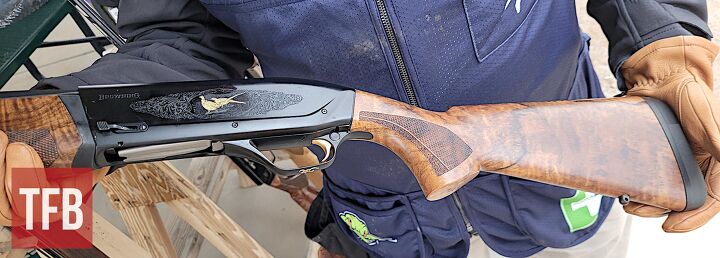
You can generally hunt ruffed grouse, jackrabbits, squirrels, snowshoe hares, raccoons and most other animals around this size on whatever small game licenses are issued by your local state or provincial government, or other licensing authority. However, small game hunting is also different from waterfowl hunting; you need a separate license for that, and usually you need special equipment. I’d even argue that upland hunting is very similar to small game hunting, but not the exact same thing.

Small game hunters are looking for any targets of opportunity, generally, not just zeroed in on flushing pheasants.
Good small-game shotguns
Once upon a time, the North American and European markets were filled with high-quality shotguns that were built to last a family (dad, and then his sons as they grew up) for a lifetime of small game hunting. Then, after World War II, gunmakers focused more on low pricing and volume, and less on building quality, hand-fitted metal-and-wood hunting guns.
But you can still find good guns for small-game hunting at all ends of the price spectrum. If you’re new to hunting, I’d definitely recommend you start with a shotgun, because you can hunt almost anything with it in most jurisdictions. A .22 rifle might not be legal for game birds in your region, but a shotgun will blast bunnies and birds both (and bucks, too, if your local regs allow it, which they probably do). In short: A shotgun makes a lot of sense for beginners, even if you’re on a budget.
Here’s a quick list of some good options if you’re based in the States, ranked on their pricing.
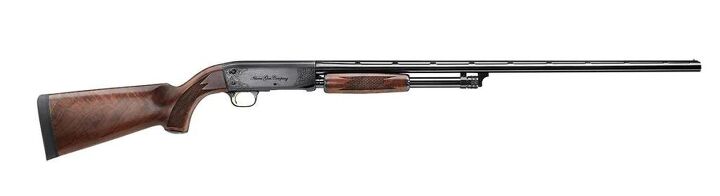
Feelin’ Spendy: Ithaca Model 37 28 Gauge
You might think this shotgun is completely antithetical to classic small game hunting. Ithaca lists the Model 37 28 gauge at an MSRP of $1,999 to $3,499. We’ve come a long way from the quality-but-affordable small game guns of the past! But the reality is, if you were making many of those shotguns today, they’d require a price tag similar to this Ithaca, which is why they’ve been replaced by guns with a lot of aluminum and plastic parts, and an overseas origin.
So if you’ve got the green, this might be the nicest small game shotgun currently made in the USA, especially because it’s built on a specific 28 gauge frame; smaller than a 20 gauge, larger than a .410. You can get it with a 24-inch, 26-inch or 28-inch barrel, and Grade A, Grade AA or Grade AAA walnut stock. Bottom-load and bottom-eject means lefties can use this almost as easily as right-handed shooters (the safety is still a button-style on the trigger guard, not an ambi tang safety).
I’m not about to order one of these, but I’d sure like to try one on a grouse hunting trip in Quebec next year.
Feelin’ sensible: Henry H15 Single Shot Shotgun
I would argue the single-shot shotgun has always been linked to small game hunting, and these days, the Henry H15 is the only single-shot still built in the U.S., as far as I know. And they’re still built to a high standard, with your choice of pistol-gripped stock and steel receiver or English straight-gripped stock and brass receiver (MSRP $625 for the steel receiver, $770 for the brass version). You can order these shotguns in 12 gauge, 20 gauge or .410; I’d personally go with the 20 gauge for its versatility, its slightly shorter 26-inch barrel and its lower recoil.
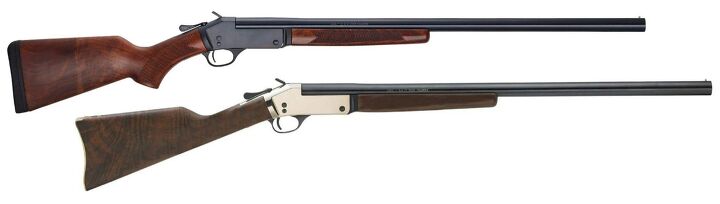
I will not deny that these are a bit pricey for a single-shot shotgun, but Henry stands behind their products and these guns will last you a lifetime. They’re also available in youth sizes. They’re light, they’re trim and tidy, and the 12 gauge and 20 gauge even come with a removable choke, so you can play around with your pattern. They’re a buy once, cry once option, and most small game hunters will never wear one out.
Feelin’ skint: Maverick 88 All-Purpose
If you’re low on funds, buy the Maverick 88. There is simply no better all-around gun for your money in 2026. It currently carries a $290 MSRP for this version, which is available in 20 gauge or 12 gauge. If you’re buying in-store, I’d recommend you try on the Bantam model for fit, as the 22-inch barrel will be a little more handy in the woods, although perhaps not as good for wingshooting, and the stock will be too short for many adults.
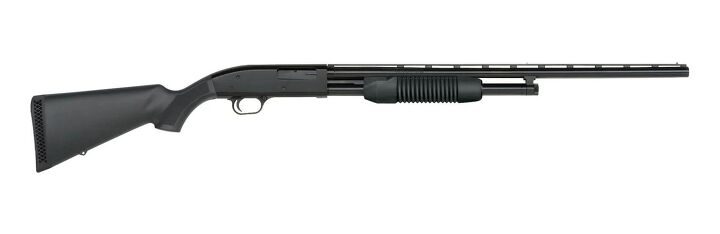
The Maverick 88 is still kinda-sorta made-in-the-USA and is only $10 more than made-in-China single-shots from the competition. Down the road, you can add a slug barrel to the Maverick for deer hunting, or a shorter 18.5-inch barrel for home defense, or … whatever else you can dream of. It’s basically the same gun as the Mossberg 500, and I had friends who could buy any duck gun they wanted, and they swore by their Mavericks. They aren’t flashy, but they’ll fill the pot at a very reasonable price.
Rifles for small game hunting
The name of the game here is rimfire. Most small game rifles are chambered in .22LR, but .22 Magnum is very popular among serious small game hunters as well. I could happily go with either option, as long as you’re making headshots.
Feelin’ Spendy: CZ 457 Lux
This is a small-game gun that feels like a big-game rifle. Personally, I love full-sized rimfire rifles, and they’re getting harder to find these days. The CZ 457 Lux offers you the choice of .22LR or .22 Magnum (and .17 HMR too, if you’re feeling crazy …), and it’s supposed to have MOA accuracy in the right hands (and with the right loads). Adjustable sights come standard, and an adjustable trigger, with a walnut stock. With a 24-inch barrel, you get a long radius with those irons, and they’re considered very good (which is often not the case with rimfire rifles these days).
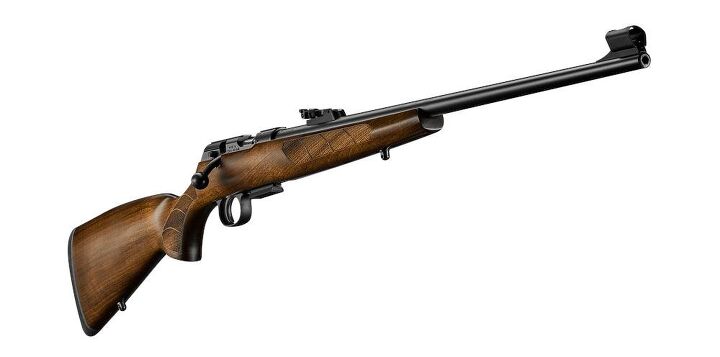
Best of all: It’s actually not that expensive. While CZ’s U.S. website doesn’t list an MSRP, these rifles can be found as low as $650-$700 brand-new. That’s a very reasonable price tag for a well-made European rifle that will last a shooter a lifetime. See Rusty’s review here.
Feelin’ sensible: Henry H1 Tracker Rifle/Carbine
Henry used to sell the Small Game Rifle (review here), explicitly built for this kind of hunting. The lineup sees some slight jiggling this year, but the H1 Tracker is pretty much the same idea, just with a different name. Its MSRP is $650 for the base model in .22LR, barely less money than the CZ 457 Lux, and .22 Magnum will drive it up higher. Of course, like the CZ, real-world prices are typically lower as long as you can find the rifle in stock.
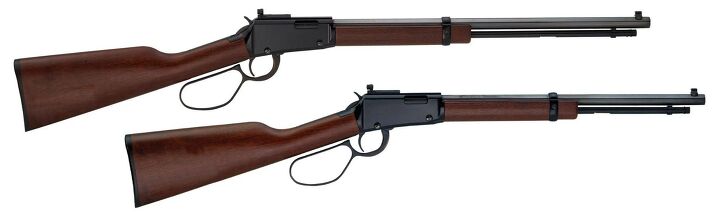
The Henry H1 Tracker comes with a receiver peep sight for better open-sight shooting (although you can easily mount a scope if you wish). A good set of irons is most welcome on a small game gun, and most of the competition cheaps out here. The Henry will cost you more, but it’s set up for small game hunting right out of the box, with no aftermarket peep sights needed. And unlike some other lever-actions, the .22LR Henry will also handle .22 Short, which some shooters might find preferable for their lower sound.
There’s something distinctly American about hunting with a lever-action, and while lever guns are increasingly pushed out of big game hunting due to their price and perceived limitations, they make perfect sense for small game hunters. With a walnut stock and octagonal barrel, H1 Tracker is a gun with classic good looks, and it should serve you well.
Feelin’ skint: Savage Mark II F
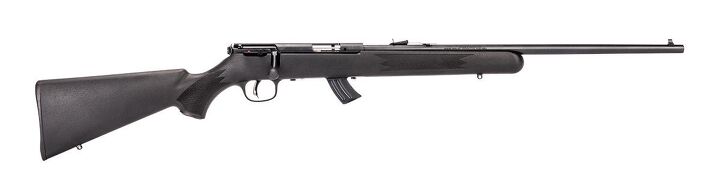
This is one of the most accurate-for-your-money .22LR rifles ever made, embarrassing big-buck competitors at rimfire precision matches across the continent as long as the shooter can find the ammo the rifle likes. MSRP for the AccuTrigger model starts at $299, but Wal-Mart sells the non-AccuTrigger model for $179 in the U.S., and that gun will fill the pot just fine. The Savage Mark II is made in their Lakefield plant in Canada; it’s a design that goes back for many decades, and it’s also available in .17 HM2 and the new .21 Sharp.
But the .22LR version is the one I’ve personally owned in the past and found very accurate. I once earned the eternal respect of my neighbor by head-shotting a cormorant (legal in my region) in his fish pond on a very windy day; the old guy thought I was a real Deadeye Dick after that, although it was simply a combination of dumb luck, plus a rifle that shot far better than its price tag would imply. It did the same thing every time I took it rabbit hunting, too, as long as there were rabbits around to hunt. The magazines were a bit janky, the rifle felt a bit crude in the hand, but it was excellent value for the money and I’d recommend it to anyone.