The gap between classroom de-escalation performance and street application, what the research shows about verbal technique under stress, and what distinguishes training that transfers from training that produces a certificate.
Welcome back to Front Line Friday. This week is an editorial week, and the topic is de-escalation training, specifically the gap between what officers can do in a classroom scenario and what they actually do during a high-stress street contact. De-escalation has become one of the most politically loaded topics in law enforcement training over the last decade, and that political weight has distorted the conversation in both directions. Agencies under pressure to show de-escalation training hours have implemented a curriculum that satisfies the political requirement without addressing the transfer problem. Officers skeptical of the training have sometimes rejected techniques that, properly taught, would be genuinely useful. The research points to a narrower and more actionable set of conclusions than either camp typically acknowledges. Front Line Friday is brought to you by Dead Air Silencers, whose support keeps this column going every week.

This is not a policy argument about when force is appropriate. That line is set by law, agency policy, and the specific facts of each encounter. This is about the science of training verbal intervention skills and what it takes for those skills to be available when the physiological and cognitive conditions of a high-stress contact make everything harder to access.
Front Line Friday @ TFB:
Why De-escalation Training Has a Transfer Problem
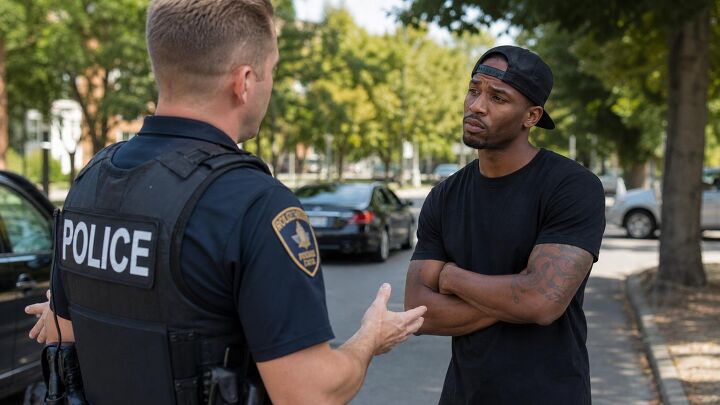
De-escalation as a skill category has a transfer problem that most training programs do not address directly. The problem is not that verbal techniques do not work. Research on crisis communication, motivational interviewing, and tactical communication clearly shows that trained verbal approaches produce better outcomes than untrained improvisation across a range of contact types. The problem is that the conditions under which those techniques need to be applied, physiological arousal, time pressure, ambiguous threat cues, and a subject who may be actively non-cooperative or in behavioral crisis, are precisely the conditions that suppress access to learned verbal behavior in favor of more automatic responses.
This is the same transfer problem that affects any cognitive skill trained under low-arousal conditions and then required under high-arousal conditions. An officer who has completed eight hours of de-escalation classroom training has been exposed to the concepts, has practiced verbal exchanges with cooperative role players, and has received feedback on technique. What they have not done is assess those techniques in light of a sympathetic nervous system response that narrows attention, compresses cognitive flexibility, and shifts processing toward a threat response rather than a deliberate verbal strategy. The classroom performance and the street performance are products of different cognitive states, and training that does not bridge that gap produces knowledge that stays in the classroom.
The most well-documented illustration of this problem is the verbal command research from shooting simulation studies. Officers who perform well on verbal de-escalation scenarios in role-play settings frequently revert to a small set of habitual command phrases under time pressure in force simulators, regardless of what the simulation scenario called for. The verbal repertoire that exists in slow cognition is not reliably available in fast cognition. Training that does not specifically address the fast-cognition access problem addresses only about half of the skill requirement.
What the Research Shows About Verbal Technique Under Stress
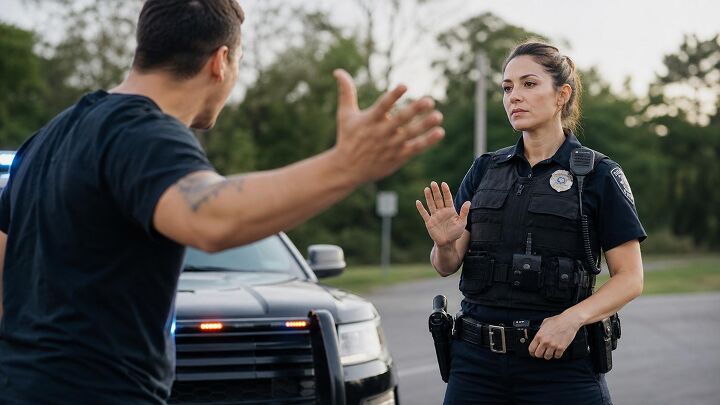
The research on verbal techniques under stress converges on a few findings that are sufficiently consistent to be operationally useful. First, tone and prosody carry more weight than content during high-arousal interactions. A subject who is significantly emotionally elevated is processing the officer’s voice at a different level than a calm subject. The specific words used matter less than whether the voice conveys calm authority versus urgency and threat. Officers who can modulate vocal tone deliberately under stress, slowing the rate of speech, lowering pitch, and reducing volume rather than increasing it, produce different physiological responses in the subject than officers who match the subject’s arousal level.
Second, the research on crisis communication consistently supports a containment-and-time approach over rapid compliance demands in situations involving subjects in acute mental health crisis, significant intoxication, or extreme emotional distress. The pressure to achieve rapid compliance, a natural response to ambiguity and time pressure, often escalates situations rather than resolving them. An officer who can tolerate the discomfort of a contact that is not immediately resolving, maintain a safety perimeter, reduce the number of competing voices, and allow time to work has a tool that is more effective than any specific verbal technique in a significant subset of difficult contacts. That tolerance is trainable. It requires repeated exposure to the discomfort of unresolved situations in training, not just techniques for resolving them faster.
Third, validation before direction is a sequence that appears in multiple evidence-based communication frameworks, including motivational interviewing and crisis intervention team training, and has consistent support in the de-escalation research. Acknowledging what the subject is expressing before issuing a direction is not a tactical concession. It is a communication sequence that reduces resistance to the subsequent direction by signaling that the officer has processed the subject’s emotional state rather than ignoring it. Officers who move directly from subject behavior to a directive without acknowledging the subject’s expressed state produce more resistance than officers who first use a brief validation sequence, even when the directive’s content is identical.
Fourth, research on multi-officer contacts consistently shows that having one officer speak at a time is associated with better outcomes than multiple officers issuing simultaneous or conflicting directives. The subject processing multiple simultaneous voices, each with different content or tone, has a higher cognitive load than the subject processing a single calm voice. High cognitive load in an already-elevated subject does not produce compliance. Establishing clear communication and taking responsibility at the start of a multi-officer contact is a simple protocol that consistently reduces vocal competition, yet it is rarely trained explicitly.
The Skill Architecture Problem in Current Training
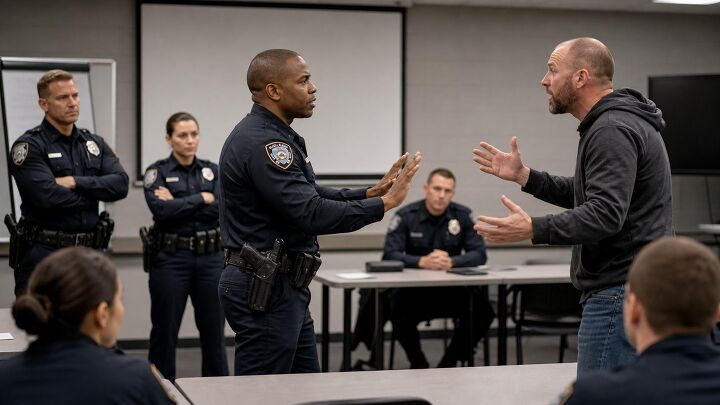
Most de-escalation training is structured as concept delivery followed by supervised role-play under low-stress conditions. The officer learns the framework, practices the techniques with cooperative role-players, receives feedback, and completes the training block. That structure is adequate for producing classroom-level understanding and initial skill acquisition. It is not adequate for producing stress-accessible behavior because it does not include the critical component of practice under conditions that replicate the arousal state where the skill needs to work.
The parallel to firearms training is direct. A recruit who learns trigger control, sight alignment, and the shot process in a static-target environment has acquired the cognitive framework for accurate shooting. That cognitive framework does not automatically transfer to accurate shooting under time pressure, after a foot chase, in low light, or at close range with a dynamic target. The gap between static-range performance and force-simulator performance is why law enforcement agencies invest in scenario-based and stress-inoculation training for firearms skills. The same gap exists for verbal skills, and the same solution applies. Verbal de-escalation techniques need to be practiced under conditions that produce physiological arousal, not just in low-stress role-play environments.
Stress inoculation for verbal skills looks different from stress inoculation for firearms skills, but the principle is the same: introduce the physical arousal state, practice the target behavior within that state, and build the neural pathway that makes the behavior accessible when arousal is elevated. That can be accomplished through high-fidelity scenario training with role players specifically trained to escalate, through virtual reality simulation environments that elicit measurable arousal responses, or through integrated scenario training that pairs a physical stress component with a verbal skill requirement. All three approaches have shown better transfer outcomes than classroom-only training in the available research. None of them is cheap or fast to implement, which is part of why classroom training remains the dominant model despite its known limitations in transfer.
The repetition volume problem is also real and underacknowledged. De-escalation techniques need repetition to become automatic enough to be available under stress, and the repetition volumes required for stress-accessible skills exceed what a single annual training block can provide. Eight hours of de-escalation training per year may satisfy a policy requirement. It does not produce the repetition volume needed for reliable stress-accessible performance. Agencies that are serious about de-escalation as an operational capability rather than a reporting metric build repetition into roll call training, scenario rotation, and FTO program requirements, not just the annual curriculum block.
What FTOs and Field Experience Actually Transmit
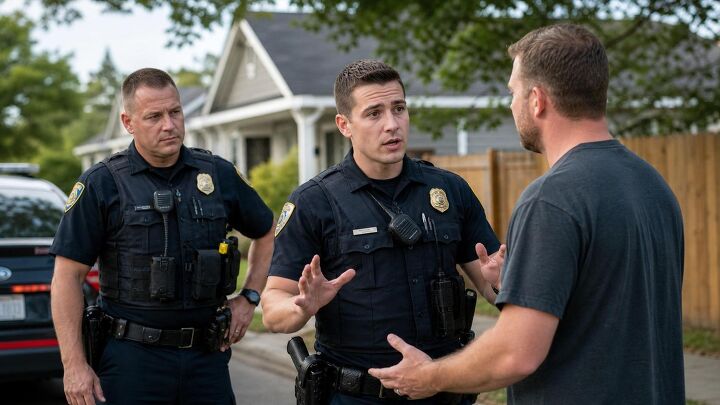
Field training transmits de-escalation behavior in ways that classroom instruction does not, but the quality of what is transmitted depends entirely on what the FTO models. Officers learn verbal behavior primarily through observation and imitation of experienced officers, and the patterns transmitted in FTO programs reflect the accumulated habits of the individual FTO rather than the evidence-based curriculum the agency delivered in the academy. An FTO who defaults to high-command volume, rapid compliance demands, and minimal validation sequences is conveying a verbal approach likely to produce more resistant contacts than an FTO who models deliberate pacing, validation-before-direction, and tolerance for unresolved time. The academy curriculum does not survive contact with contradicting field experience.
This is not an argument that FTOs are doing it wrong. Many experienced officers have developed effective verbal approaches through years of trial and error and accumulated contact experience that research would recognize as evidence-consistent. The problem is that effective verbal behavior in experienced officers is often tacit knowledge, meaning the officer does it well but cannot articulate the framework they are applying, and tacit knowledge transmits inconsistently. An FTO who models good technique but does not debrief the verbal approach after a contact is transmitting behavior that a new officer may or may not observe, interpret correctly, and incorporate. FTOs who debrief verbal approaches explicitly, naming the specific technique and explaining the reasoning, produce more reliable transmission than FTOs who simply model the behavior and expect observation to be sufficient.
The related issue is that verbal approach debriefs are not standard in most FTO programs. Use-of-force debrief protocols are common. Vehicle pursuit debrief protocols are common. A structured debrief of the verbal contact approach after a difficult interaction is rare, and the absence of that debrief means the most teachable moments for de-escalation skill development pass without the explicit processing that makes them learning events rather than just experiences.
Bottom Line / What to Do Monday
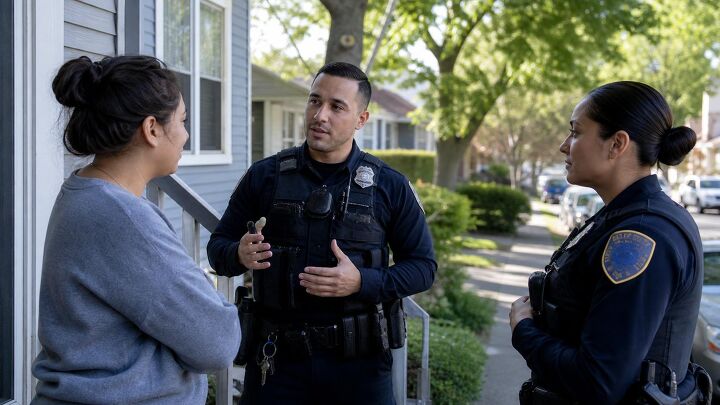
- After your next three difficult verbal contacts, spend two minutes before clearing the scene doing a quick self-debrief: what did you say first, what was the subject’s response, what changed the trajectory of the contact? You do not need a supervisor present for this. You need the habit of processing verbal approach as a skill variable rather than just a feature of the contact.
- Practice slowing your speech rate on routine contacts where there is no pressure to do so. The skill of deliberate vocal pacing needs repetition to be available under arousal. Routine contacts are where the repetitions accumulate cheaply. The officer who has practiced slower, lower vocal delivery on five hundred routine contacts has a different default than the officer who has never practiced it at all.
- On multi-officer contacts, establish verbal lead before making initial contact with the subject. One sentence to the other officer before contact, naming who is talking, eliminates the most common source of simultaneous conflicting directives. This is a 30-second protocol that meaningfully changes the communication environment.
- If your agency’s de-escalation training is exclusively classroom-based, that is worth raising with your training coordinator as a transfer gap rather than a content gap. The question is not whether the techniques taught are evidence-based. The question is whether the training structure produces stress-accessible skill or classroom-only knowledge. Those are different problems with different solutions.
- FTOs: after difficult verbal contacts, debrief the verbal approach explicitly, not just the tactical decisions. Ask the trainee what they said first, what the subject’s response was, and what they would do differently. Make the verbal technique as much a subject of the structured debrief as the positioning and force-option decisions. The contacts that do not go smoothly are the highest-value learning events in the FTO program when processed deliberately.
- Supervisors: if your unit’s use-of-force reports consistently describe verbal approaches in a single sentence or less, that is a documentation gap and potentially a training gap. Officers who cannot articulate what verbal approach they used and why may not have a deliberate verbal approach to articulate. That is a training design problem, not an individual performance problem, and it requires a training solution rather than a counseling solution.
- Fire/EMS: Research on verbal techniques in medical crisis response mirrors law enforcement findings. Tone, pacing, and validation before instruction lead to better patient cooperation and reduced scene complexity during behavioral health contacts. EMS providers working frequent behavioral health calls benefit from the same repetition-in-routine approach as patrol officers: practice deliberate vocal pacing on non-acute transports, so it is available on acute ones.
That’s Front Line Friday for this week: de-escalation training that produces classroom performance is not the same as de-escalation training that produces street performance, and the gap between them is a structural training design problem with a known solution that most agencies have not implemented. The techniques are not the problem. The conditions under which they are practiced are. Next week, we are on radio communication under stress, covering the specific verbal failures that most often appear on dispatch recordings from complex incidents and what research on high-stakes communication shows about how to prevent them.