What belongs in a patrol vehicle trauma kit beyond the issued IFAK, how to organize it for access under stress, and the consumable rotation discipline that keeps it functional when it matters.
Welcome back to Front Line Friday. This week is a gear week, and the topic is the in-car trauma kit: specifically, the gap between what agencies issue as a personal IFAK and what a well-configured vehicle-based trauma kit actually looks like when it needs to support a mass casualty or multi-patient scenario. Week 3 covered the individual first aid kit and foundational skills in tourniquet application and wound packing; this is not a repeat of that. This is about what lives in the car, how it is staged, and why the difference between a kit configured for access under stress and one assembled for inspection matters more than the contents list. Front Line Friday is brought to you by Dead Air Silencers, whose support keeps this column going every week.

The IFAK on the belt is designed for one patient, one officer, and a short window. The vehicle kit is designed for everything the IFAK cannot handle: a second patient, extended operations, supplies to hand off to arriving EMS, and backup capacity when the IFAK has been used or isn’t accessible.
Front Line Friday @ TFB:
Why the Vehicle Kit Is a Different Tool Than the IFAK
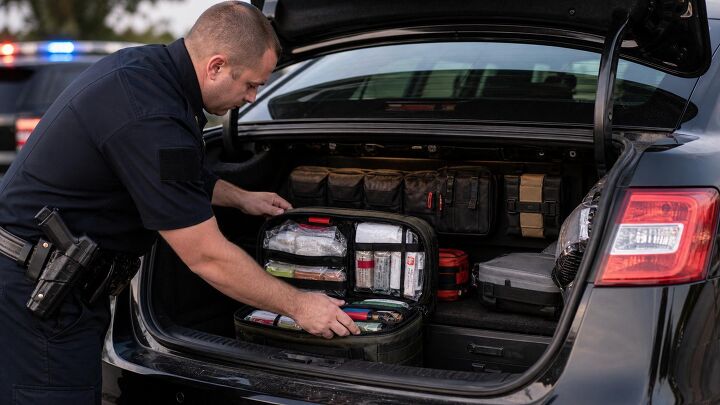
The issued IFAK solves a specific problem: one officer, one patient, one acute hemorrhage or airway event, immediate intervention. It is sized and configured to be carried on the body, which means the contents list is constrained by what fits on a belt or a vest panel and what an officer can access one-handed under stress. Those constraints are correct for the problem the IFAK is designed to solve. They are the wrong constraints for what a patrol vehicle medical kit needs to do.
The vehicle kit operates in a different scenario envelope. It is not a backup IFAK. It is a second-tier capability that extends the officer’s ability to manage trauma before EMS arrives, support multiple patients, supply arriving officers or bystanders rendering aid, and hand off organized resources to EMS so they can move faster upon arrival on scene. A vehicle kit that is just a larger IFAK is missing the point. A vehicle kit that is organized around that handoff function, stocked for multi-patient scenarios, and configured so items can be located and retrieved in low light and under stress is doing what it is supposed to do.
The scenario that exposes the difference is not an isolated officer-involved shooting where EMS is four minutes out. It is an active threat with multiple victims, an officer working a scene alone for eight to twelve minutes before additional resources arrive, and injured civilians who cannot be moved to a better position for care. That scenario requires more than two tourniquets and a chest seal. It requires additional hemorrhage-control supplies for multiple extremity wounds, the ability to manage a casualty with airway compromise, and enough organized supplies that a second officer arriving on scene can immediately identify what is available and what has been used.
Be careful of the vehicle trauma kit that lives in the trunk and has never been opened since the initial issue. A kit with an intact manufacturer seal or factory packaging that has been in service for two years is a kit that no one has verified, practiced with, or maintained. Seals confirm contents at packing. They do not confirm the kit is current, complete, or configured for the vehicle and officer using it.
Change the framing from “do you have a vehicle kit” to “can you retrieve the tourniquet from your vehicle kit in the dark in under ten seconds.” The first question gets a yes from almost every officer. The second question gets a much more useful answer.
What the Vehicle Kit Should Contain

The vehicle kit contents should be built around the most likely severe trauma presentations in patrol work: extremity hemorrhage, junctional hemorrhage, penetrating torso trauma, and airway compromise. That is not a comprehensive emergency medicine kit. It is a focused trauma kit designed to keep a patient alive for the interval between injury and EMS arrival, and the contents list reflects that specific mission rather than the contents of a paramedic’s drug bag.
Hemorrhage control is the core. The vehicle kit should carry, at a minimum, four Combat Application Tourniquets (CATs) or equivalents, two packages of hemostatic gauze, and two pressure bandages. That is enough to address two extremity hemorrhage casualties simultaneously with redundancy. Agencies that carry one tourniquet in the vehicle kit are configured for one patient, which is not the scenario that exposes the gap between adequate and inadequate. Junctional hemorrhage, wounds to the groin, axilla, or neck that a limb tourniquet cannot address, requires a junctional tourniquet device or additional wound packing material and pressure. At least one junctional option should be included in the vehicle kit.
Chest trauma management requires vented chest seals, a minimum of two pairs. Penetrating chest trauma can produce tension pneumothorax if untreated, and vented seals allow air to escape while sealing the wound. Chest seals represent a meaningful intervention capability for penetrating chest wounds that would otherwise have no field treatment available.
Airway management in the vehicle kit does not need to replicate a paramedic airway kit. A nasopharyngeal airway in two sizes, with appropriate lubricant, addresses the most common pre-hospital airway management need that an officer is likely to encounter and is within the scope of most Stop the Bleed and TECC protocols. The NPA does not require advanced training to use correctly and is significantly more effective than jaw thrust alone for an unconscious patient with an obstructed airway.
Beyond the trauma core, the vehicle kit should carry nitrile gloves in multiple sizes, trauma shears, a permanent marker for tourniquet time documentation, and a mylar emergency blanket. None of those are exotic items, and all of them serve a function that gets used more often than the tourniquet. The mylar blanket specifically is undervalued: hypothermia is a significant complication in trauma patients, and a patient in hemorrhagic shock who is also losing core temperature is a patient whose survivability window is narrowing faster than the hemorrhage alone accounts for.
Be careful of vehicle kits stocked with non-TECC-standard items because they were cheaper, available, or already on hand. A pressure bandage that an officer has never trained with, a tourniquet brand with a different windlass mechanism than what the officer practiced on, or hemostatic gauze in a format that differs from what the agency trained on creates hesitation at the moment when hesitation costs time. Kit contents should match training materials, not procurement convenience.
Change the contents list conversation to start with scenario requirements rather than available SKUs. The question is not “what can we get in this bag” but “what do we need to manage two penetrating trauma patients for ten minutes?” Build the list from that scenario, then source the contents.
Organization and Staging for Stress Access
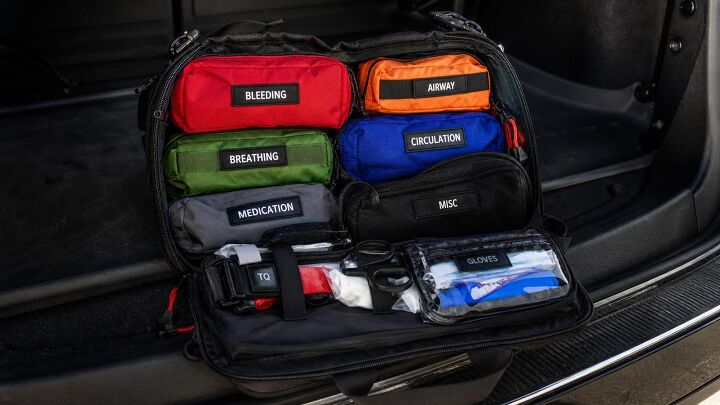
A kit with the right contents configured for impossible access in a stressful scenario is not a functional kit. The organizational principle for a vehicle trauma kit is the same as for any gear that needs to be used quickly under stress: highest-probability items at the top and outer positions, consistent location across all configurations, and a layout the officer can navigate by touch in low light. That last criterion is the one most vehicle kits fail.
The typical vehicle trauma bag is a soft-sided bag with a zipper closure and contents that shift. After two months in the trunk of a patrol vehicle, the tourniquet that was on top is under the pressure bandages, the chest seals have migrated to the back, and retrieving anything specific requires opening the bag, finding what you need, and then closing and re-staging it. Under stress, with a patient, at night, that process takes significantly longer than it does in a parking lot demonstration. The solution is a rigid or semi-rigid kit with dedicated compartments or MOLLE attachment points for individual items, so the tourniquet is always in the same position and can be retrieved by reaching directly to it without searching.
Vehicle placement matters as much as internal organization. A kit in the trunk is not accessible from outside the vehicle without going to the back, which is a significant problem in an active-threat scenario where the vehicle may be in a contested position. A kit mounted in the rear passenger compartment, accessible from the driver’s seat through the pass-through or from either rear door, is accessible in a wider range of scenarios. The tradeoff is interior space, which matters for prisoner transport, and that tradeoff is worth making explicitly rather than defaulting to trunk placement because that is where it fits.
External marking on the vehicle kit container is worth considering for scenarios where arriving officers or EMS need to locate it quickly without asking. A bag clearly marked as a medical kit, with a consistent color or marking convention that matches the department-wide standard, reduces the time required to identify resources when multiple people are working a scene.
A problem is officers who know they have a vehicle kit but cannot describe where in the trunk it is, what the exterior looks like, or what is in the primary access pocket. If an officer cannot describe their kit without looking at it, they have not practiced accessing it, and they will not locate it quickly under stress.
Kit placement evaluation should be part of the vehicle setup conversation during FTO, not an afterthought. Where the kit lives, how it is oriented, and how fast it can be retrieved are configuration decisions that should be made deliberately and checked during the onboarding process.
Consumable Rotation and Expiration Management
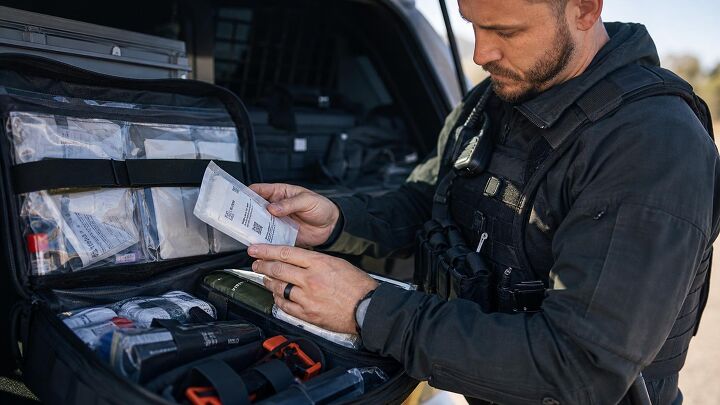
A trauma kit is a consumable system. Tourniquets, chest seals, hemostatic gauze, and NPAs all carry expiration dates that reflect meaningful changes in material performance over time. Hemostatic gauze that is past expiration has degraded kaolin or chitosan activity and may not perform at the same level as in-date material. Chest seals with compromised adhesive from heat cycling in a vehicle trunk may not seal as intended. A tourniquet windlass repeatedly exposed to high heat over multiple summers may exhibit material fatigue that is not visible externally. None of these failure modes is hypothetical. They are predictable degradation patterns in materials stored in the thermal cycling environment of a patrol vehicle.
The rotation discipline for a vehicle kit is straightforward but requires a system to execute consistently. Every item with an expiration date should have that date noted somewhere accessible, either on the item itself or on a card attached to the kit interior. A monthly check is sufficient for most consumables. The check takes three minutes if the kit is organized correctly. It takes significantly longer and is more likely to be skipped if the kit requires unpacking to verify contents.
Heat exposure is the variable that most vehicle kits are not managed against. In a southern climate, a patrol vehicle in summer can reach interior temperatures above 140 degrees Fahrenheit with the windows closed. That temperature range significantly accelerates the degradation of adhesives, polymer components, and certain hemostatic agents, faster than the expiration date calculated for ambient-temperature storage. Agencies in high-heat climates should apply a more aggressive replacement schedule for vehicle kit consumables than the manufacturer’s expiration dates suggest, and the kit’s storage position within the vehicle matters. Kits stored in direct sun contact on dark interior surfaces experience greater heat exposure than kits stored in lower positions with some thermal isolation from the vehicle body.
Used items need an immediate replacement protocol, not a quarterly resupply cycle. An officer who uses a tourniquet from their vehicle kit on Tuesday and does not have it replaced until the agency’s next medical supply order in three weeks has a capability gap that the agency may not be aware of. A simple report-and-replace procedure, where use of any vehicle kit item triggers an immediate replacement request, keeps the kit at operational readiness rather than in the state it was in at the last inspection.
Be leery when you see expiration dates on vehicle kit supplies that have been crossed out and re-dated. This practice exists in some agencies as a budget workaround and reflects a misunderstanding of what expiration dates represent. The date is not an administrative suggestion. It reflects a tested performance threshold that the manufacturer stands behind. A re-dated item has not been re-tested.
Agency procurement cycles for medical consumables should include a line item for vehicle kit rotation, scheduled to account for actual storage conditions rather than calendar intervals. A kit stored in a Phoenix patrol vehicle in July requires a different replacement timeline than the same kit stored in a Seattle patrol vehicle in January, and procurement schedules should reflect that difference.
Bottom Line / What to Do Monday
- Open your vehicle kit today and retrieve the tourniquet without looking. If you cannot locate it by touch in under ten seconds, the kit is not organized for stress access. Reorganize it so that the primary hemorrhage-control items are in consistent, accessible positions before the next shift.
- Check every expiration date in your vehicle kit. Flag anything past date or within 90 days of expiration and submit a replacement request. If your agency does not have a replacement request process, document what has expired and bring it to your supervisor. An expired kit is not functional, regardless of how complete it looks.
- Count your tourniquets. If your vehicle kit carries fewer than four, you are configured for one patient. The scenario that exposes that gap is not rare. Add capacity if your agency’s procurement process allows individual vehicle augmentation.
- If your vehicle kit is in the trunk, time yourself retrieving the tourniquet from a standing position outside the vehicle’s rear. Then time yourself retrieving it from the driver’s seat. If the trunk-access time is significantly longer or impossible from the driver’s seat, evaluate whether repositioning the kit to the rear passenger compartment is feasible for your vehicle configuration.
- FTOs: include a timed vehicle-kit access drill in the vehicle-familiarization portion of the FTO program. New officers should demonstrate they can retrieve primary items from the vehicle kit by touch, in low light, before they are signed off on vehicle setup. This is a thirty-minute exercise that builds a skill that does not degrade quickly once established.
- Supervisors: add vehicle kit expiration check to your inspection checklist if it is not already there. A unit inspection that verifies the kit is present but does not verify its contents or expiration dates does not verify kit readiness. The distinction matters when the kit is needed.
- Fire/EMS: apparatus medical kit rotation is typically handled through formal supply management systems, but individual crew members benefit from knowing the expiration status of their primary access items, not just that the apparatus passed its last inspection. The kit that is in spec at quarterly inspection may have items near expiration between cycles, and knowing that matters when you are the one using it.
That’s Front Line Friday for this week: a vehicle trauma kit configured for stress access, stocked for multi-patient scenarios, and maintained at current readiness is a different tool than the kit that passes inspection and sits undisturbed in the trunk. The gap between those two configurations is not a procurement problem. It is a setup-and-maintenance discipline problem, and it is solvable at the individual officer level without waiting for agency action. Next week, we are in de-escalation training, covering what the research shows about which training approaches actually transfer to the field and which ones produce classroom performance that disappears at the first real contact.