When a soldier takes a round to the shin or catches a blast that fractures the tibia, the traditional response pulls two to four additional service members off the line to haul a litter, plus a security element to cover them. That’s a significant combat power cost for a single casualty. The U.S. Army Medical Research and Development Command has been working on a better answer since 2020, and the result is IBEX, the Intrepid Battlefield EXoskeleton.
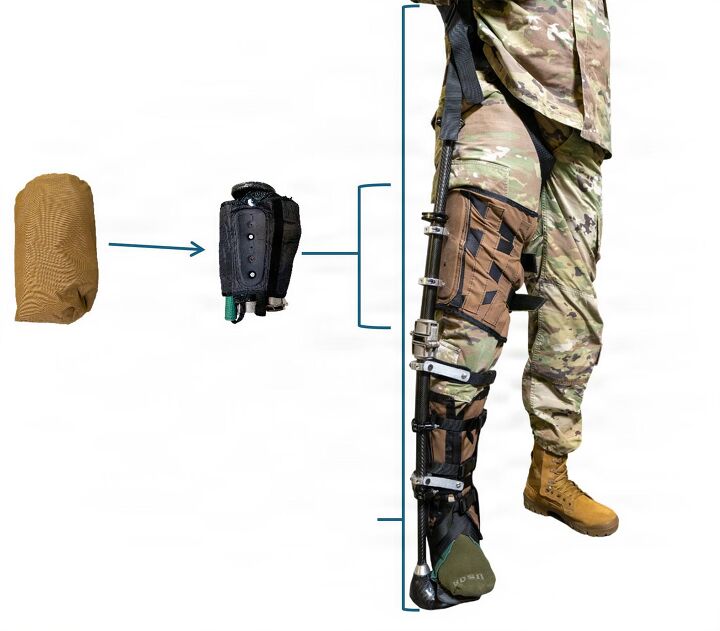
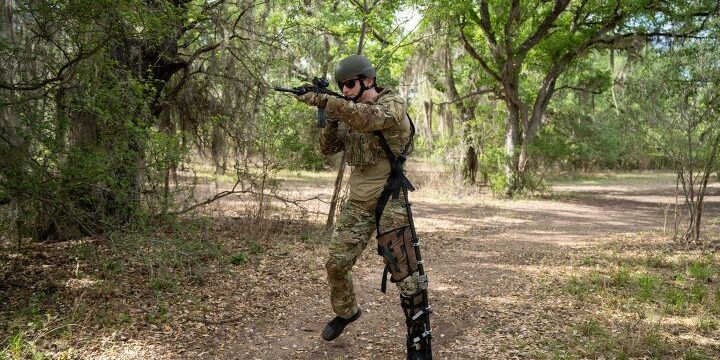
IBEX is a wearable exoskeletal frame designed to stabilize lower-leg injuries, including tibia fractures, torn knee ligaments, high-grade ankle sprains, and foot fractures, while transferring the wearer’s body weight through the device rather than the injured limb. The goal is to convert a non-ambulatory casualty into a walking wounded, letting an injured service member move independently to cover, to a casualty collection point, or to a vehicle, without requiring fellow soldiers to break from the fight to carry them.
Dr. Lee Childers, senior scientist at the Extremity Trauma and Amputation Center of Excellence (EACE) Military Performance Lab at the Center for the Intrepid, Brooke Army Medical Center, framed the problem plainly: “In combat, troops suffer tibia fractures, torn knee ligaments, high-grade ankle sprains, and foot fractures; these are the most common but survivable battlefield injuries. The IBEX enables more walking wounded, which means more warfighters putting bullets downrange while providing a smaller target for enemy drones to attack.”
That last point is worth underscoring in the current threat environment. Litter carries are slow, visible, and resource-intensive, presenting exactly the kind of target that loitering munitions and reconnaissance drones exploit. Anything that reduces the signature and duration of a CASEVAC evolution has legitimate tactical value beyond the immediate care of the individual.
The system is built around a telescoping lateral frame paired with a hip harness, thigh corset, knee joint, lower-leg fracture splint, and a walking boot with a rocker-bottom sole. Critically, the injured limb’s movement is isolated from the load-bearing frame, relieving pressure on soft tissue, nerves, and blood vessels to reduce pain and limit secondary damage. The design also permits the wearer to drop to a prone firing position and recover to standing, which matters when self-evacuation routes aren’t clean.
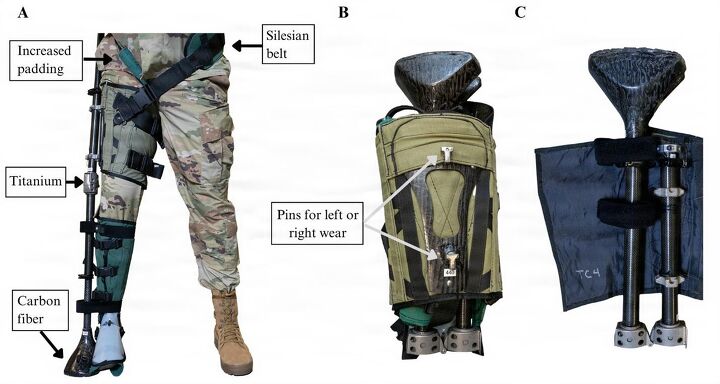
When collapsed, IBEX packs into the thigh corset to a volume roughly equivalent to a one-liter water bottle, approximately 6 inches wide, 7 inches deep, and 15 inches long, at a weight of seven pounds. That package is small enough to be carried by a unit medic, a fellow soldier, or delivered by cargo drone; IBEX has already survived a 400-foot drone drop in testing. The U.S. Army, Navy, and Marine Corps have completed field trials.
The program started in 2020 and is now on its third funding round with a fifth-generation prototype in hand, each iteration reducing size and weight while improving function. IBEX has been licensed to a commercial partner, and development continues toward a final prototype suitable for manufacturing. The next round of testing is scheduled for early next year at the outdoor training grounds near Brooke Army Medical Center.
Between 2001 and 2018, service members deployed to combat zones suffered just over 22,000 non-amputated lower-leg injuries, per research published in the National Library of Medicine, with approximately 68 percent classified as open wounds or fractures. IBEX was developed specifically for prolonged field care scenarios where evacuation is delayed or unavailable, the conditions under which those injury statistics were generated and where the device’s self-evacuation concept has the most operational relevance.
The IBEX – the Intrepid Battlefield EXoskeleton, in short:
- Weight: 7 lbs
- Packed dimensions: ~6″ W x 7″ D x 15″ L
- Packed volume: approximately 1-liter water bottle equivalent
- Drone delivery tested: 400-foot drop
- Generation: 5th prototype
- Program start: 2020
- Services tested: U.S. Army, Navy, Marine Corps
- Target injuries: tibia fractures, torn knee ligaments, high-grade ankle sprains, foot fractures.