State of the Industry Q1/Q2 2026

In a world where anyone with a smartphone can upload content saying whatever they want with a confident tone, that’s enough to be extremely misleading or distracting on a variety of topics we’re passionate about in these circles— unintentionally out of cognitive dissonance, or deliberately and disingenuously, both of which we see often and even recently. In light of this, it’s important to be able not just to know how to sift through the noise to isolate the solid information, but where and from whom to obtain it.
Once again we’ve spoken with Duane Liptak (Executive Vice President of Magpul) to get a bead on what’s going on and what’s worth paying attention to amidst a backdrop of noise, conjecture, and fluff. The graphics you see posted throughout this piece will link back to their respective sources, should you wish to read further and go down the rabbit hole.
State of the Industry is going to be a new periodical column here at the TASKER Report, in the interest of keeping you up to date on the important developments within our sphere, to inform and enable better decisionmaking and purchasing power among the readers. If any other industry insiders wish to contribute to future volumes of this column, please reach out via support@taskernetwork.com

SITREP: How are we looking, overall?
“2026 is looking strong, and seems to be a growth opportunity year for a good number of companies, although as with most years and most trends apart from true hyperactivity— responses on this may vary across the industry as a whole.”
How are we looking on the political, legislative, and judicial front? Are there any specific challenges you’re aware of, or irons in the fire (like litigation in progress) worth paying attention to?
“This is an important area right now. Certainly there are state level injustices, like VA and the continuing infringement efforts in CO, and elsewhere, to strip rights, that in a post-Bruen world, are clearly unconstitutional. Nationally, at least through midterms, there is little risk of negative legislation gaining any traction, but the losses in the states that place the agenda of control over citizen rights and safety will need to continue to be challenged.
There are several bright spots. The elimination of the tax on SBRs and suppressors continues to help make the case for eliminating those items from the NFA entirely, which is appropriate, as the entire NFA should be abolished. The cases making those arguments are working their way through the system, and those efforts deserve support. The big one will be getting AWB (Assault Weapons Ban) and magazine ban cases heard by SCOTUS. They are stacking up in conference, and we have some indication from Harmeet Dhillon (AAG in the 2A Civil Rights Office) that we may see movement soon. Positive findings on those issues would go a long way towards setting things right across the nation in the restoration of rights. We would no doubt see near immediate attempts in anti-freedom states to work around any such decision, as we did with the carry and permit decisions affecting NY, et. al., but it would depend on the wording of any decisions as to what those workarounds might be, and I’m sure the legal challenges to enjoin them would be immediate.
Finally, on the regulatory front, there are definitely some bright spots. I’m probably more skeptical than most about ANY politician actually having the true best interests of freedom in mind, but I’m pleased as I suppose I can be with the recent regulatory corrections of past abuses and the direction of the administration with respect to the guidance given to the ATF and DOJ. The regulatory reforms are actually meaningful, and to have a DOJ challenging AWB and magazine bans is a drastic change from previous administrations. There are some good people doing good work on these fronts, and I look forward to seeing this trend continue. I’ve had conversations with WH (White House) counsel as well as the 2A civil rights office, and I was very happy with that dialog. Politics is politics, but they all genuinely seem to want to move the needle, and they are willing to engage with the 2A rights community to shape priorities, which is very refreshing.”
How are we looking with respect to the economy? Has the Iran War had an effect on the materials & production supply chain— boom or bust? What’s your perspective on Trump Slump 2.0 and the effects in the short and long term? Has demand for firearms industry products (guns, accessories, gear, training, etc) fallen, picked up, or stabilized?
“Fuel prices drive up the prices on everything production related, as well as truckload, LTL (less than truckload), and small parcel shipping, while at the same time assaulting family budgets with the general increases felt on everything else. It’s definitely time to make sure we as an industry are doing everything as efficiently as possible, but that’s generally a continuous task in a well-run organization, anyway.”
How are we looking with respect to innovation and product development? Have you seen or heard about anything at SHOT or NRAAM that caught your attention? What direction do you think the industry is trending towards as it relates to development of optics, suppressors, ammo (high pressure AKA hypervelocity, like NAS3), firearms, etc? With respect to the majority small arms focus, is the industry still following the whims of .mil demands or have they started to venture out in their own directions as .mil requests for new items have decreased? Is the future of innovation (all together) incremental at this point, given all that has been achieved over the last 20 years?
“Given the zero tax shift and additive manufacturing capabilities, there has certainly been a surge in companies offering suppressors, as demand increases.
High pressure ammunition, as well as the associated cartridge case, operating systems, propellant, and projectile advancements are likely to reshape the landscape of small arms. What can be done right now with projectile velocity while staying within safety margins for port pressures, bolt face thrust, and case construction is truly impressive, and there is a lot of effort being put into this field. On the military side, it’s to some extent the continuation of the age-old races between arms and armor developments that have been going on for thousands of years, but because of the compatibility with existing firearms in many cases, these advances are likely to make their way mainstream relatively quickly, and indeed, have already started. Advantages in external ballistics, cartridge efficiency, and terminal performance are very real.
As far as overall development, I certainly see no slowing down. US and international militaries have their priorities for force modernization and their requests to the industry for those areas, and it’s still busy. The citizen market certainly has its trends, as well, and there is opportunity to solve problems everywhere. It’s just a matter of finding the right ones to work on for the core competencies of the company doing the development work. The handgun market is strong, good rifles are in demand, and there are still areas to improve the tools we count on every day. Not every development or new product is category redefining, and some trends can be more fashion than substance, but there’s nothing wrong with that, either. Sometimes the crawl of evolutionary small advancements, or even items that at first seem like novelties, create a spark that leads to something larger.”
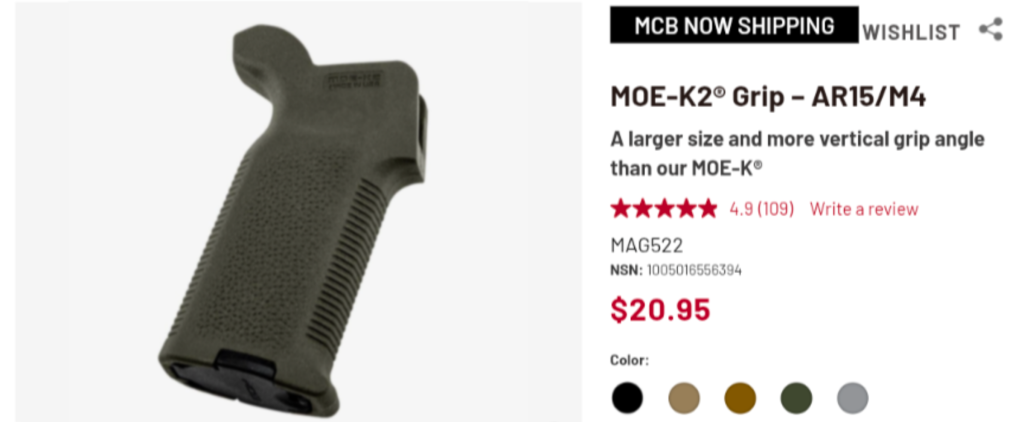
How’s it going at Magpul? What can we look forward to from there? Anything new you can reveal that will be debuting in the near future? Will the new colors you’ve introduced be extended to all polymer products eventually?
“We’re busy. We’ve got a ton of development programs underway in numerous areas, and we’re doing a slightly better job about staying quiet about things until they are ready. We have a bunch of Magpul product releases slated for the second half of the year, some very cool OEM partnership programs underway— and more in the planning phase, along with some military oriented programs that will also be appealing to the larger market. And yes, you’ll continue to see the logical proliferation of color through the line as well as logical line extensions for fitment and application in other areas.”
We’ll touch base with Duane again in Q3/Q4 2026 for an update, given the typical pace of industry development cycles. Until then,
Stay Dangerous.
Stay in this L.A.N.E.