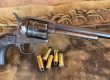
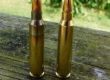
You don’t have to be Dirty Harry to see the value in having a big-bore magnum by your side. The .44 Remington Magnum is highly regarded as a hard-hitting and accurate round that provides phenomenal stopping power. It’s no surprise that there’s a large number of manufacturers producing .44 Magnum ammo in a variety of styles for a range of shooting applications.
Introduction to the .44 Mag
Developed by Remington Arms, Smith and Wesson, and legendary firearms enthusiast Elmer Keith, the .44 Magnum was designed as a handgun cartridge to hunt medium to large game, as well as defend against dangerous animals in the wilderness. S&W produced the original .44 Magnum revolver, later called the Model 29, and announced it to the public at the beginning of 1956.
The round was created by lengthening the .44 Special casing and loading it to much higher pressures. This resulted in the most powerful handgun cartridge in the world at the time.
By the end of the year, Ruger entered the market with the Blackhawk single-action revolver chambered in .44 Mag. In the late 1960s, Winchester and Marlin released the first lever-action rifles chambered in the round. The .44 Mag gained a cult following in the 1970s when the Model 29 was featured as Clint Eastwood’s sidearm in Dirty Harry. Ever since, the .44 Magnum remains popular among firearm enthusiasts due to its incredible performance and adaptability.

.44 Magnum vs. .44 Special
The .44 Magnum was engineered off of the older .44 S&W Special cartridge. The case was lengthened and powder was added to offer a higher-pressure, high-velocity round capable of pushing a 240-grain bullet up to 1,500 fps. Original pressures reached 36,000 psi, and this number was later increased to 40,000 psi.
.44 Special is a softer shooting cartridge pushing the same bullet at velocities between 700 and 900 fps. Its mild recoil is easy to control for fast follow-up shots. It can be useful for defense against two-legged predators when overpenetration is a concern. Similar to the .357 Magnum and .38 Special, .44 Magnum firearms are capable of firing .44 Special ammunition as well, but not the other way around.
The .44 mag often gets lumped in with the .44-40 Winchester cartridge as well. However, they are not interchangeable. The .44 Winchester is a low-pressure, black powder round primarily used by Cowboy Action shooters.
.44 Magnum: Rifles vs. Handguns
The .44 Mag is an extremely versatile cartridge. In revolvers, it offers a stout round in a compact package easy to pack for handgun hunting or defense in the field. In rifles, energy increases to .30-30 Winchester territory. The increased barrel length allows for full powder burn for increased velocity and muzzle energy. Velocity can increase by 300 to 400 fps, while energy can rise 600 to 700 ft/lbs.
The recoil of .44 Magnum can be quite snappy. This is mitigated when used in a rifle, which is heavier and soaks up more of the recoil. A rifle also allows for improved purchase on the firearm for greater control, with three points of contact (both hands and the shoulder).
Rifles, as well as longer 6 and 8-inch revolvers to some extent, provide an increased sight radius, allowing for greater accuracy. Additionally, shooters can use scopes or optics for better precision.
.44 Magnum rifles and revolvers offer a distinct advantage in that they allow for a rifle/sidearm pairing utilizing the same cartridge. Extra ammunition can be used in either firearm depending on your needs, and both are powerful enough to handle an assortment of tasks.
Today, the .44 Magnum is widely used for hunting, self-defense, and target shooting, and it is available in a variety of firearms.

.44 Magnum Ballistics
.44 Magnum ballistics will largely depend on whether you’re using a handgun or rifle. With barrel lengths ranging between 2.5 inches and 20+ inches, it’s not shocking that results may vary.
Bullet Weights and Types
.44 Magnum bullet weights typically range between 180 and 300 grains, but they can go as low as 158 grains and as high as 340 grains. Lighter loads offer higher velocities for flatter trajectories. 240 to 270-grain loads provide good all-around performance for medium game hunting and personal protection. Heavy loads 300 grains and more deliver deep penetration with hard-cast bullets for increased effectiveness on large and dangerous game like elk, moose, and bear.
Bullet construction is also important. Jacketed hollow points (JHP) and semi-jacketed hollow points (SJHP) rounds are designed for controlled expansion for hunting and self-defense. Soft point (SP) rounds are for hunting, featuring an exposed lead tip that expands upon impact for an increased wound channel similar to hollow points, but at a more affordable price.
Full metal jacket (FMJ) and lead round nose (LRN) ammo is for target shooting and plinking. Solid copper monolithic bullets deliver devastating penetration for use on large game with dense tissue. Lead flat nose (LFN) or flat point (FP) rounds are great for lever-actions because they are safe to use in a tubular magazine where the butt of one round rests on the tip of the following round.
Velocity, Energy, and Trajectory
Handguns featuring barrel lengths from 4 to 8.5 inches typically send a standard 240-grain load between 1,200 and 1,500 fps. Longer 16 to 22-inch rifles and carbines increase this to around 1,600 to 1,800 fps. A standard 240-grain load fired from barrel lengths as low as 2 inches all the way up to 18 inches exhibits a velocity range from around 950 to 1,650.
The largest increases come every inch you extend from 2 to 8 inches, with smaller incremental changes the rest of the way. Lightweight, high-velocity loads can hit 2,100 to 2,200 fps in rifles and 1,300 to 1,500 fps in mid-size revolvers. Heavy, 300-grain rounds average around 1,000 fps from a 4-inch barrel and 1,500 fps in a 20-inch barrel.
All this translates to muzzle energies from 800 to 1,500 ft/lbs. This is far greater than the vast majority of handgun calibers, until you get into the specialty magnum loads such as .500 and .460. High-velocity offerings will produce a flatter trajectory and heavier options will experience increased drop, but with a 50-yard zero, a standard 240-grain load will drop roughly 2 inches at 100 yards and 8 inches at 150 yards.

Accuracy and Effective Range
From a revolver, the .44 magnum is accurate out to 200 yards for experienced shooters, and it is effective for ethical hunting to 100 yards. A rifle can squeeze out another 50 yards or so, but past that, the heavy, pistol-caliber bullet drops rapidly and loses the velocity needed for proper expansion and terminal performance.
Recoil and Shootability
Depending on the load, .44 Magnum produces 15 to 25 ft/lbs of recoil energy. This is close to four times that of the .45 ACP. From a revolver, this leads to a stout and heavy experience. A rifle distributes this force more evenly, leading to relatively mild felt recoil.
Certain grip styles can also help reduce the overall feel. Single-action revolvers tend to have a grip that rolls in your hand, which can save your wrist from harsh impact. Overmolded rubber grips can help absorb some of the shockwaves as well. Additionally, a long barrel will provide counterweight near the muzzle to help balance the kickback.
Penetration and Expansion
Hard cast and solid bullets are designed for deep penetration with minimal deformation, which leads to 30 or more inches of penetration out of the .44 Mag. It can punch right through several layers of wood and drywall, as well as dense tissue and bone. Hollow point rounds reduce this considerably, achieving around 18 to 24 inches of penetration.
Proper hollow point projectiles reaching their optimal impact velocities result in 0.70 to 0.85 inches in diameter after expansion, nearly twice their original size. Modern solid copper rounds are designed to retain as much weight as possible, allowing them to drive deep into the target while spreading. The effect is a wide, deep wound cavity capable of bringing down a variety of game.
| Cartridge | Bullet Weights (Grain) | Velocity Range (FPS) | Energy (Ft/lbs) |
|---|---|---|---|
| .44 Magnum | 158-340 | 1,200-1,500 | 800-1,500 |
| .44 Special | 135-250 | 750-1,150 | 230-550 |
| .45 ACP | 78-255 | 730-1,900 | 350-600 |
| .357 Magnum | 110-180 | 1,100-1,600 | 400-900 |
| .30-30 Winchester | 110-190 | 2,100-2,500 | 1,750-2,000 |
Hunting with .44 Magnum
Within 100 to 150 yards, .44 Magnum is an effective round for hunting medium to large game. It’s a top contender for handgun hunting, and provides solid performance from a lever-action rifle as well. Wild hog, whitetail deer, black bear, and more can all be taken cleanly with the .44 Mag. Standard 240-grain loads offer excellent results, and heavier bullets provide the deep penetration needed for larger game.
Due to the faster drop of .44 Magnum, correct range estimation is important. If you’re dialed in and practice proper shot placement, you’ll achieve good results. A nice scope or optic goes a long way in this area.
Top Loads
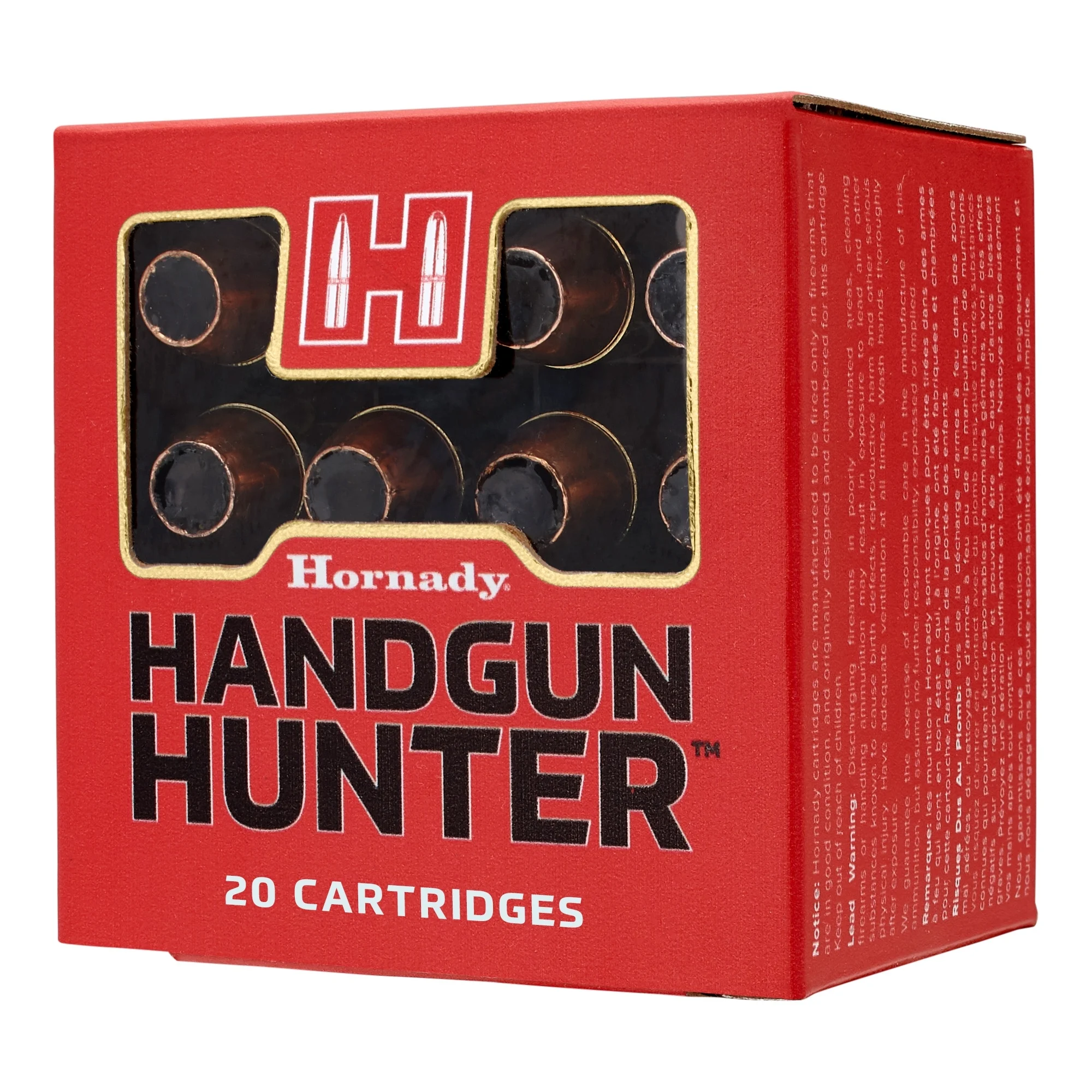
1. Hornady Handgun Hunter 200-grain MonoFlex
Hornady Handgun Hunter is designed from the ground up for optimal performance when hunting with a handgun. Featuring Hornady’s tough copper alloy MonoFlex hollow point bullet, this ammo provides deep penetration and retains 95 percent of its weight. Additionally, it incorporates an elastomer material in its open cavity that compresses upon impact and then pushes out for rapid expansion and maximum impact.
| Distance (Yards) | Velocity (FPS) | Energy (Ft/lbs) |
|---|---|---|
| Muzzle | 1,475 | 966 |
| 50 | 1,310 | 762 |
| 100 | 1,176 | 614 |
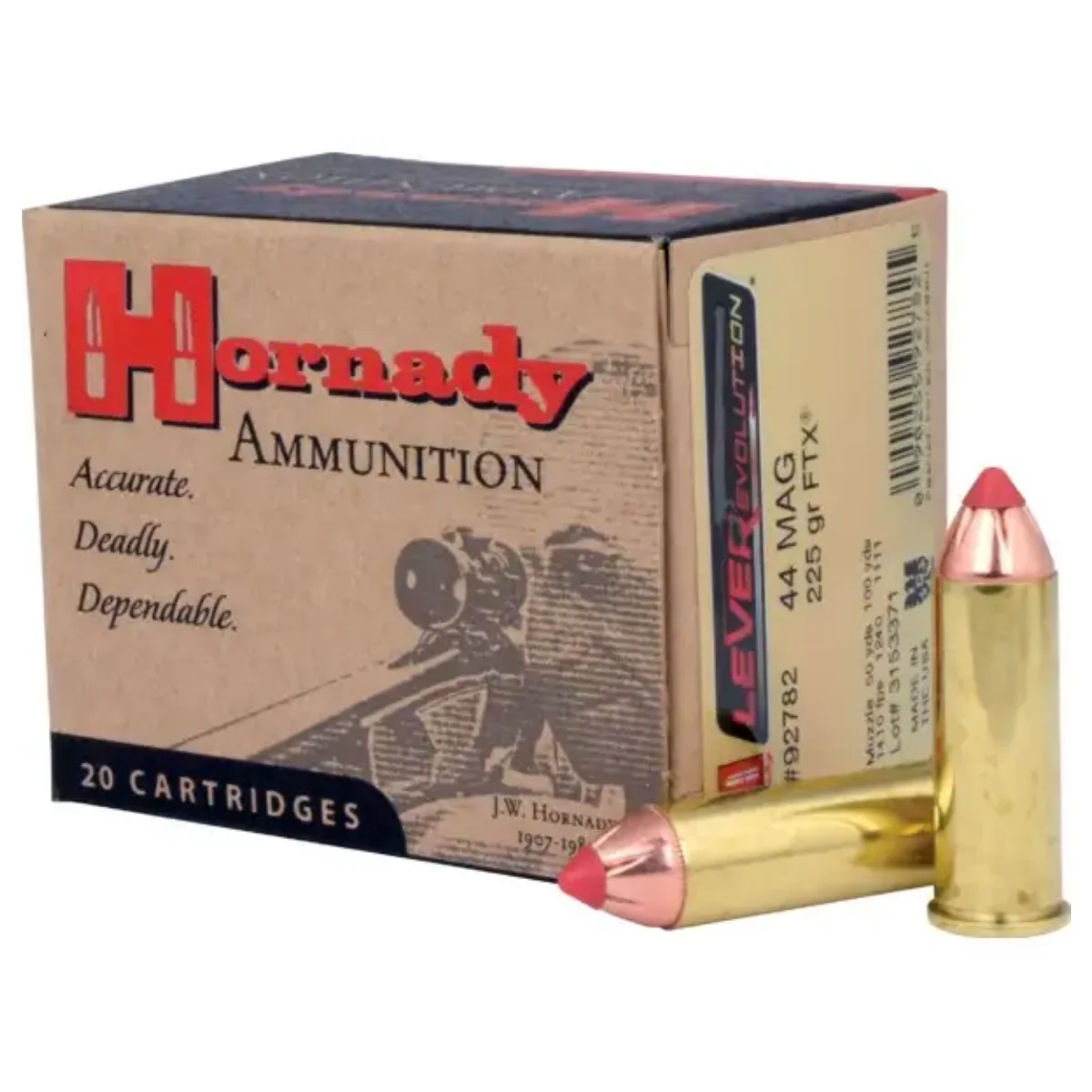
2. Hornady LEVERevolution 225-grain FTX
Hornady’s LEVERevolution is some of the best .44 Mag ammo for lever-actions. The polymer FlexTip bullet offers improved aerodynamics and higher ballistic coefficients than traditional flat point loads, while still being safe to use in tubular magazines. Further, advanced propellants provide maximum velocities for flatter trajectories and improved downrange energy.
| Distance (Yards) | Velocity (FPS) | Energy (Ft/lbs) |
|---|---|---|
| Muzzle | 1,410 | 993 |
| 50 | 1,233 | 760 |
| 100 | 1,102 | 607 |
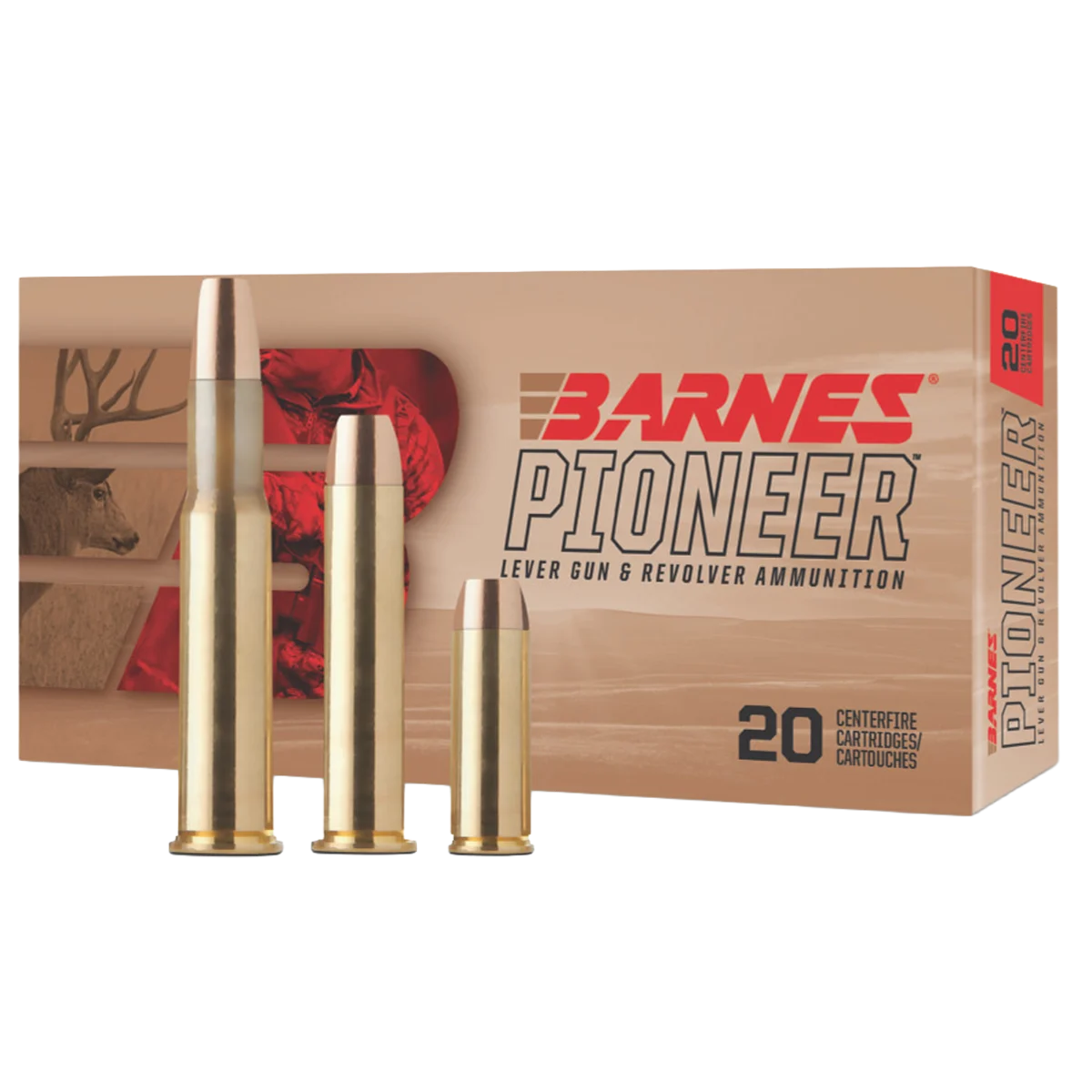
3. Barnes Pioneer 300-grain JHP
Engineered for use in lever-actions and revolvers, Barnes Pioneer ammo ensures massive expansion and weight retention for greater penetration. From a rifle barrel, the round reaches 1,325 fps and 1,170 ft/lbs of energy for exceptional terminal performance and unmatched stopping power. Numbers from a handgun aren’t quite as high, but the round is still incredibly effective. Clean-burning powders and propellants keep your firearm cleaner for lasting service.
| Distance (Yards) | Velocity (FPS) | Energy (Ft/lbs) |
|---|---|---|
| Muzzle | 985 | 946 |
| 25 | 964 | 619 |
| 50 | 944 | 594 |
.44 Magnum Self-Defense
When deciding whether or not to use .44 Magnum for self-defense, there are some considerations to examine. The round delivers incredible stopping power, far more than is typically required to stop a two-legged attacker. This leads to serious concerns about overpenetration, especially in urban environments where innocent people may be harmed. Proper shot placement and expanding hollow point ammunition are key if you’re going to go this route. In the country, this is not as big of an issue, but there is still the round’s heavy recoil and loud muzzle blast to contend with.
Self-defense against bear and large predators is a different story. This is where the round really shines. In this circumstance, increased penetration is needed to make it through the thick hide and bones of large beasts. The large diameter bullet creates a massive wound channel, even if it fails to expand. Additionally, both revolvers and lever-actions provide sufficient capacity for this application.
Top Loads
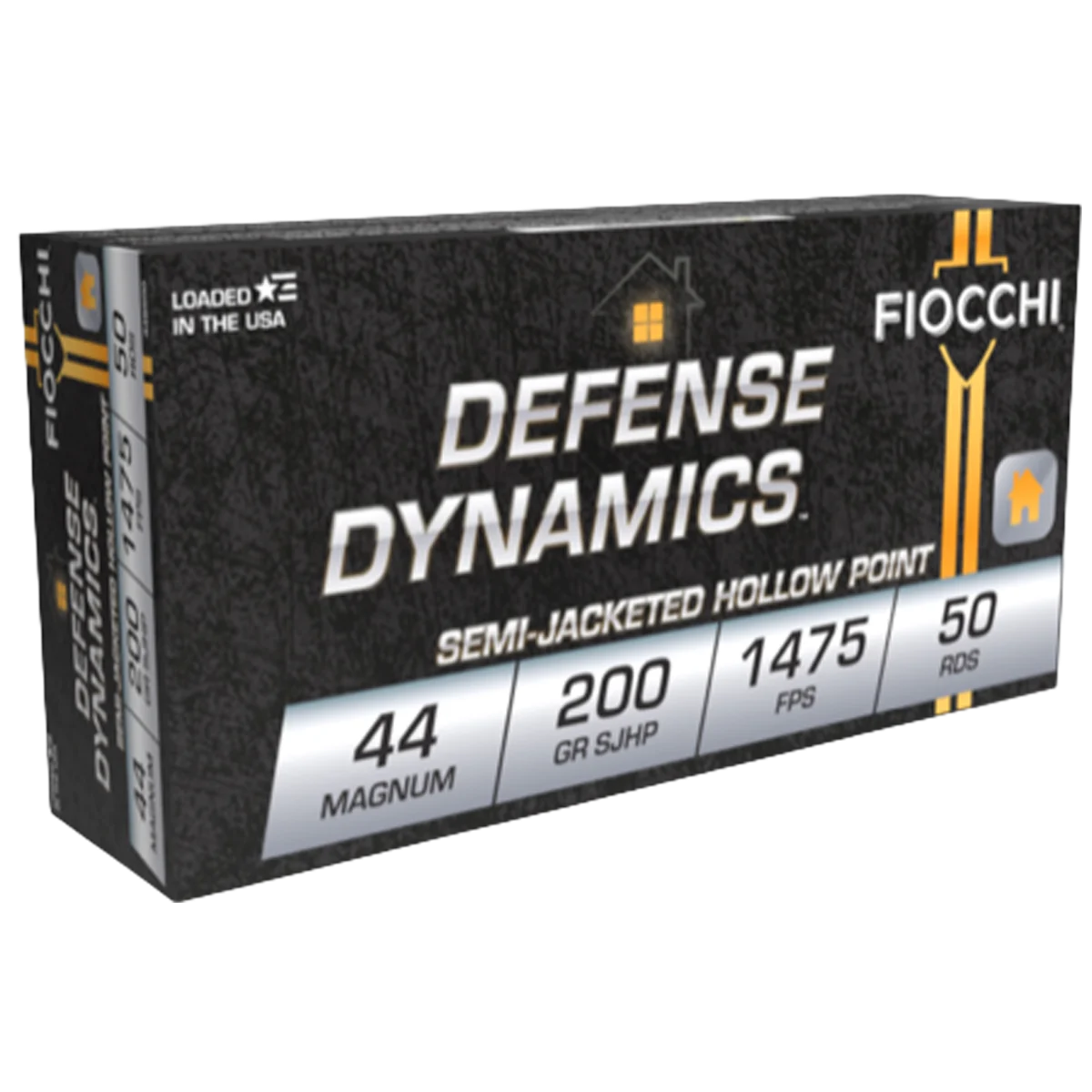
1. Fiocchi Defense Dynamics 200-grain SJHP
Fiocchi’s Defense Dynamics offers balanced performance for use in carry and duty pistols of all sizes. It is designed for reliable, consistent service and manageable recoil for use in self-defense scenarios. The semi-jacketed hollow point provides controlled expansion to reduce the risk of overpenetration while creating a larger wound cavity.
| Distance (Yards) | Velocity (FPS) | Energy (Ft/lbs) |
|---|---|---|
| Muzzle | 1,475 | 966 |
| 50 | 1,280 | 728 |
| 100 | 1,128 | 565 |
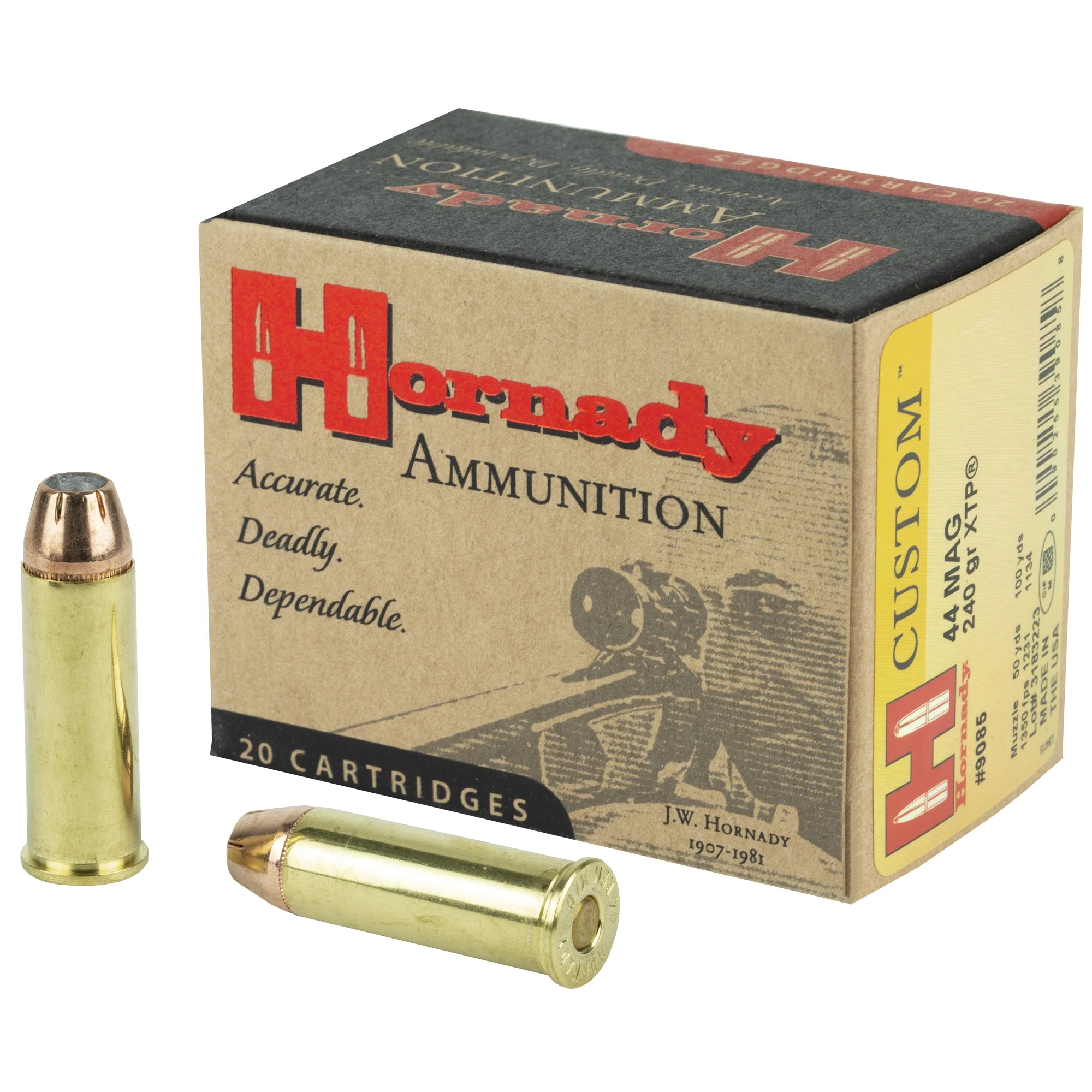
2. Hornady Custom 240-grain XTP
Hornady Custom features the eXtreme Terminal Performance (XTP) bullet, a jacketed hollow point designed with precise serrations that divide the projectile into symmetrical sections that initiate controlled expansion on impact, even at low velocities. Further, Hornady boasts that every round of its Custom ammunition is inspected by hand to ensure the highest levels of quality control possible.
| Distance (Yards) | Velocity (FPS) | Energy (Ft/lbs) |
|---|---|---|
| Muzzle | 1,350 | 971 |
| 50 | 1,230 | 806 |
| 100 | 1,133 | 684 |
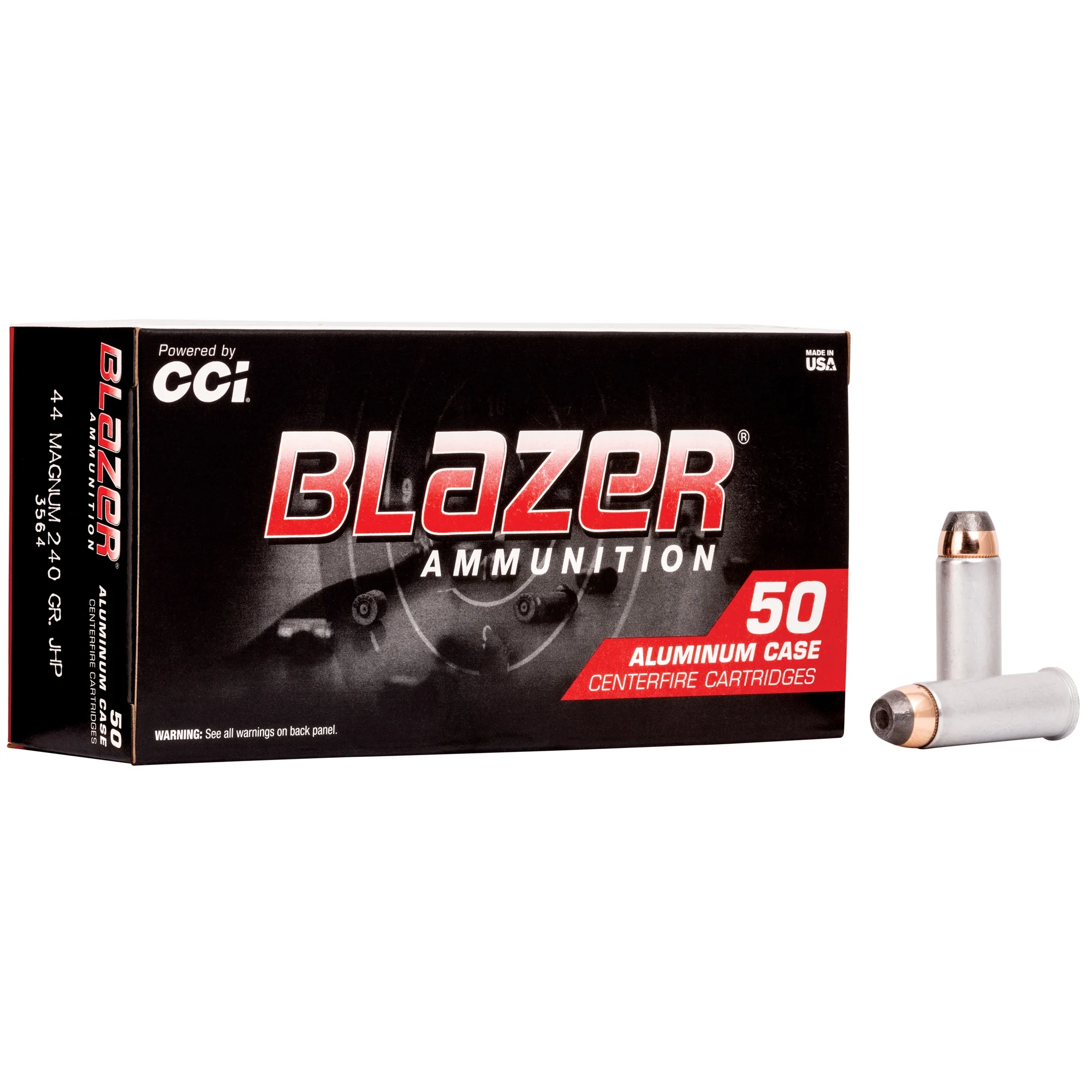
3. CCI Blazer 240-grain JHP
Designed for excellent performance on a budget, this JHP ammunition is loaded in heat-treated, aircraft-grade aluminum cases. Clean-burning powders and non-corrosive primers keep your firearm clean, allowing you to shoot more between maintenance sessions. This isn’t the hottest .44 Magnum load, but it offers enough energy to get the job done while reducing overpenetration concerns. The affordable price also allows for more practice, so you can ensure your shot placement is on point.
| Distance (Yards) | Velocity (FPS) | Energy (Ft/lbs) |
|---|---|---|
| Muzzle | 1,200 | 767 |
| 50 | 1,092 | 636 |
| 100 | 1,015 | 549 |
Target/Competition
If the recoil doesn’t bother you, the .44 Magnum offers excellent capability for target shooting. Its high velocity provides a flat trajectory at modest ranges. Additionally, the fixed barrel on revolvers allows for consistent accuracy shot after shot.
The .44 Magnum is popular for metallic silhouette competitions and bowling pin shoots. The heavy round provides plenty of power to reliably knock down these targets.
Some shooters prefer using .44 Special or downloaded .44 Mag ammo for comfortable practice and training.
Top Loads
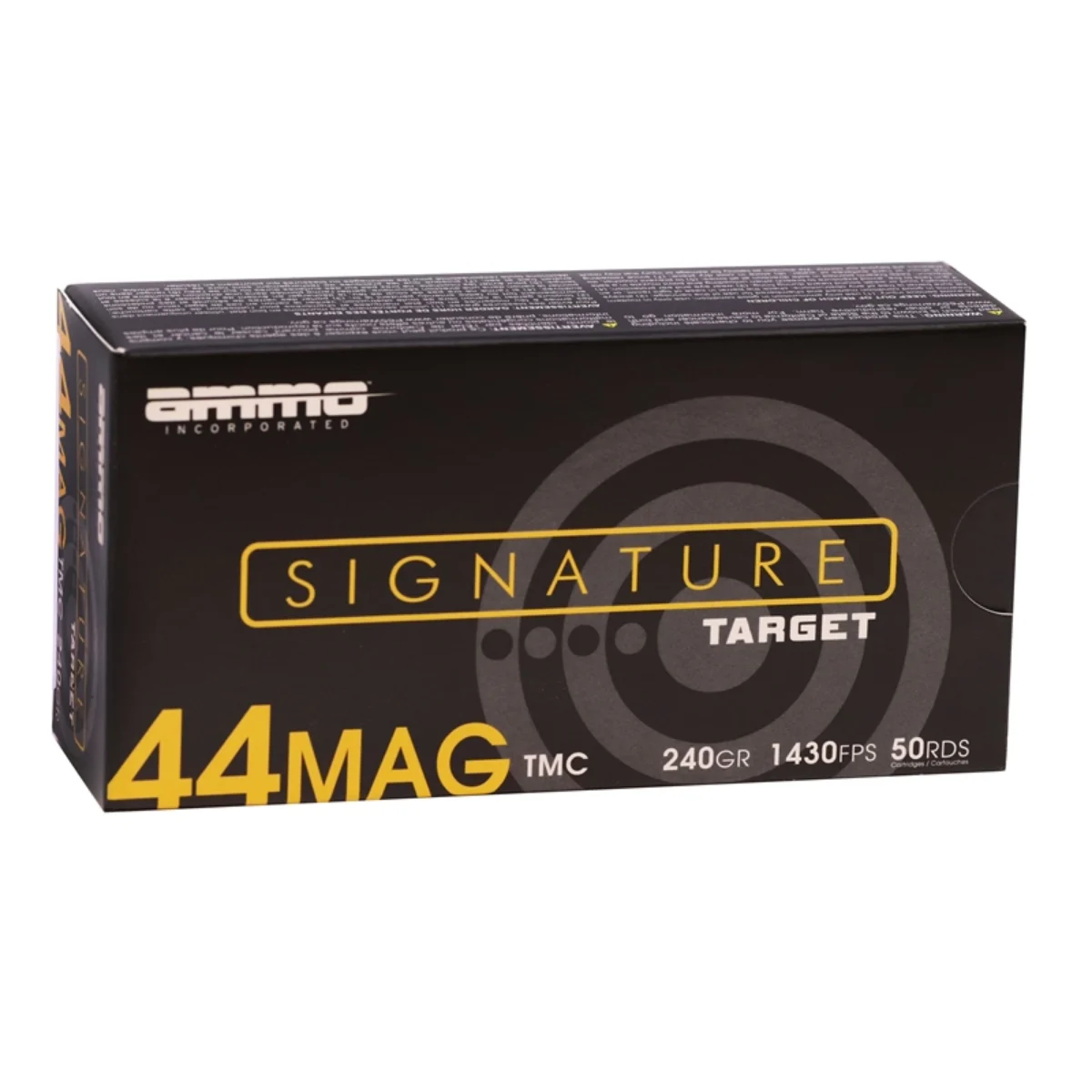
1. Ammo Inc. Signature Target 240-grain TMC
This Signature Target ammo from Ammo Inc. is perfect for target shooting and plinking at the range. The total metal coating bullet protects your firearm’s barrel from leading, and the hyperclean technology allows you to shoot more and clean less. The round does a great job at balancing velocity, accuracy, and recoil for a superior target load that comes in at a price that won’t break the bank.
| Distance (Yards) | Velocity (FPS) | Energy (Ft/lbs) |
|---|---|---|
| Muzzle | 1,430 | 1,090 |
| 50 | 1,160 | 715 |
| 100 | 998 | 531 |
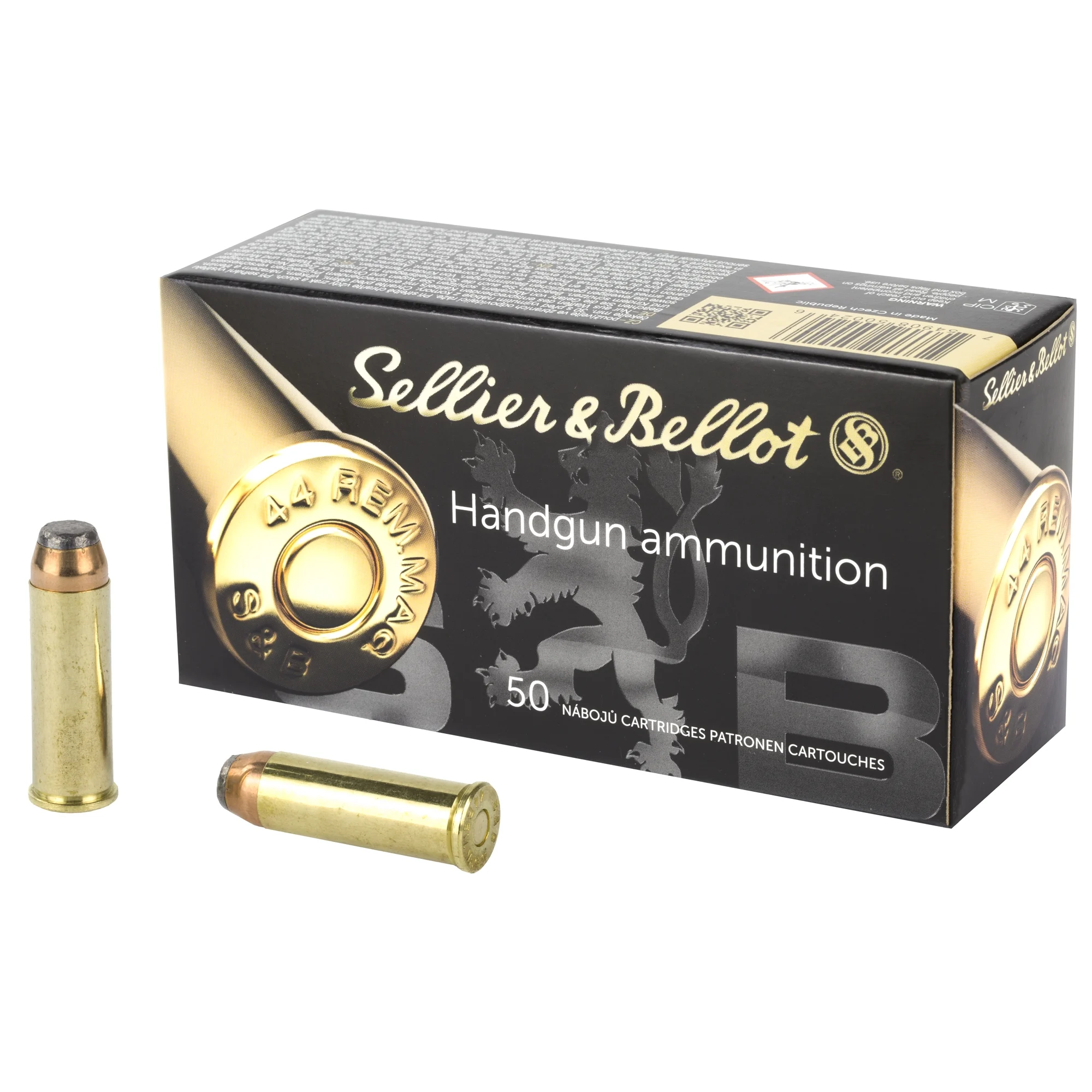
2. Sellier & Bellot 240-grain SP
This .44 Magnum load from S&B offers dependable, mid-range performance. Not too hot, not too cold, this 240-grain round hits just under 1,300 fps, producing around 870 ft/lbs of energy at the muzzle from a standard 6-inch revolver. The soft point projectile is versatile enough for hunting, defensive, and target shooting applications, making it a good all-around load to stock up on.
| Distance (Yards) | Velocity (FPS) | Energy (Ft/lbs) |
|---|---|---|
| Muzzle | 1,280 | 872 |
| 50 | 1,156 | 712 |
| 100 | 1,064 | 603 |
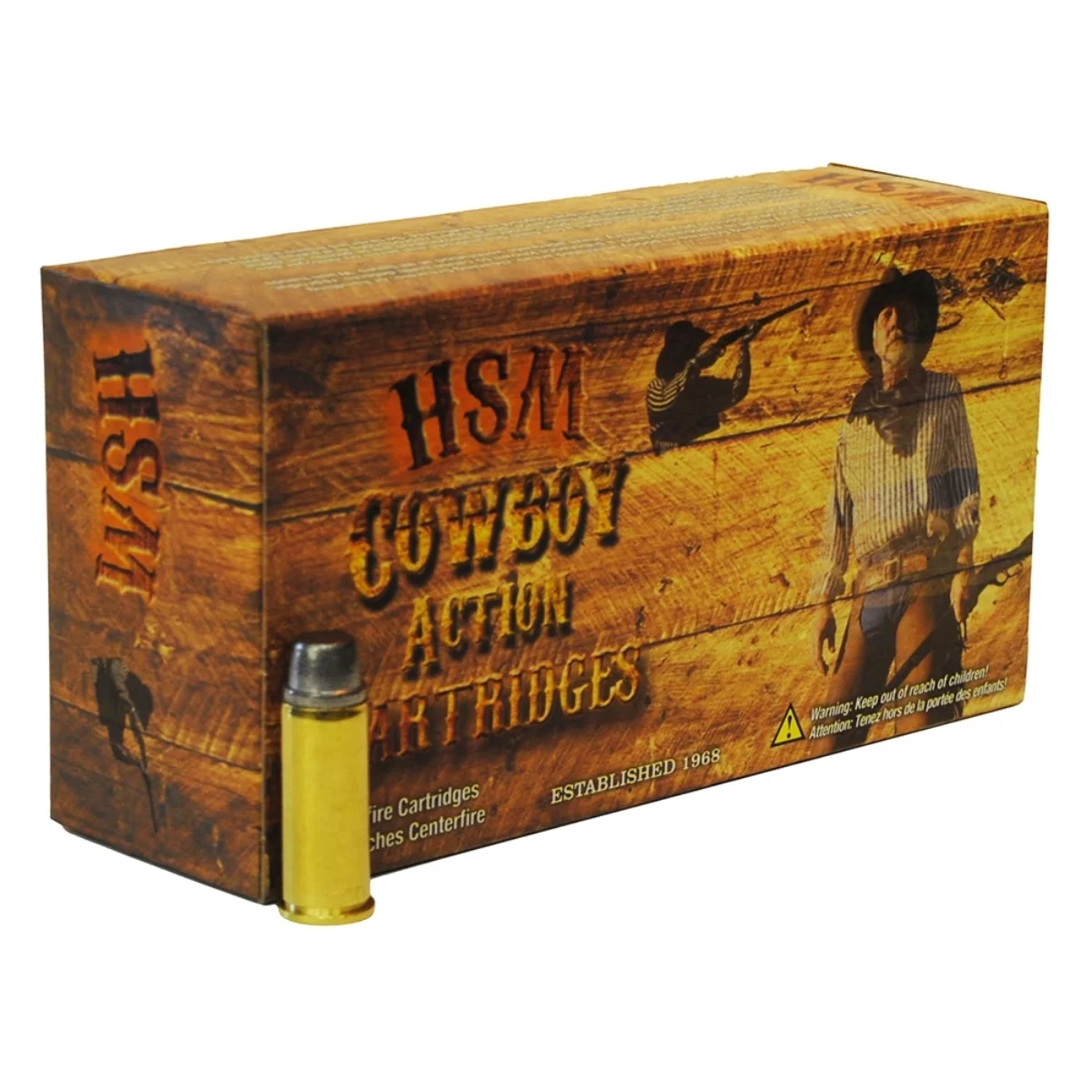
3. HSM Cowboy Action 200-grain RNFP
Featuring polished brass casings with clean-burning smokeless powders and non-corrosive primers, HSM Cowboy Action .44 Rem Mag ammo is the ultimate target and training ammo for competitive and casual Cowboy Action shooting applications. Designed for use in both revolvers and lever-action rifles, this reduced power loading won’t wear you out after a day at the range. The flat point bullet provides consistent accuracy at an affordable price.
| Distance (Yards) | Velocity (FPS) | Energy (Ft/lbs) |
|---|---|---|
| Muzzle | 975 | 422 |
| 50 | 868 | 335 |
| 100 | 781 | 271 |
Final Thoughts
Whether you’re a hunter or outdoorsman preparing for large and dangerous game, or a home defender in search of something with a bit of knockdown power, the .44 Magnum fits the bill. Fired from a rifle or handgun, the round achieves excellent results. With an ample supply of ammunition types and manufacturers, there’s a .44 Mag load for almost every occasion.
Have you hopped aboard the magnum train? What are your favorite .44 Magnum loads? Share your thoughts in the comments.
The post .44 Magnum: History, Performance, and Ammo Selection appeared first on The Mag Life.