
Why most after-action reviews produce paperwork instead of learning, the format and culture conditions that make post-incident review genuinely useful, and how to run one that officers do not dread and do not forget.
Welcome back to Front Line Friday. This week is an editorial week, and the topic is the after-action review: the post-incident process that is supposed to convert experience into improvement and that, in most agencies, converts it into a form instead. The after-action review has a good reputation borrowed from the military and aviation, where structured debrief is genuinely central to how those professions learn. What most law enforcement agencies actually run under the AAR label is something much thinner, and the gap between the reputation and the practice is why officers roll their eyes when a debrief gets scheduled. Front Line Friday is brought to you by Dead Air Silencers, whose support keeps this column going every week.

This is not an argument against reviewing incidents. It is an argument for reviewing them in a way that produces learning rather than liability documentation, and the difference between those two outcomes is mostly a function of format and culture, not effort. An agency can spend a lot of time on AARs that teach nothing and very little time on AARs that change how officers operate. The variable is how the review is run, not how long it takes.
Front Line Friday @ TFB
- Front Line Friday #17: Use of Force Documentation That Holds Up
- Front Line Friday #18: Patrol Boots and Foot Care Over a Career
- Front Line Friday #19: Fatigue and Shift Work: The Performance Data
- Front Line Friday #20: In-Car First Aid and Trauma Kit Configuration
- Front Line Friday #21: De-escalation Training That Actually Transfers
- Front Line Friday #22: Female Officer Gear and Fit: The Systemic Gap
Why Most AARs Produce Paperwork Instead of Learning

The core failure of most after-action reviews is that they are structured to document what happened rather than to understand why it happened. A review that walks through a timeline, confirms that the policy was followed, and produces a signed form creates a record. It has not created learning, because learning requires examining the decisions and the reasoning behind them, not just confirming the sequence of events. The timeline tells you what occurred. It does not tell you why the officers made the choices they did, what information they had, what they perceived, or what a different choice would have required. Those are the questions that produce improvement, and they are the questions most AAR formats do not ask.
The second failure is that AARs are frequently run as evaluations rather than as learning reviews. When a debrief functions as a judgment of whether officers performed correctly, the incentive for every participant shifts from honesty to self-protection. Officers stop volunteering what they were uncertain about, what they would do differently, or where they got lucky, because any of those admissions could be used against them. A review that punishes candor gets less candor, and a review with less candor produces less learning. This is not a character problem in the officers. It is a predictable response to a review structure that mixes learning and evaluation, and the mixing is the flaw.
The third failure is timing and format drift. An AAR conducted weeks after the incident, in a formal setting, with a form to complete, is fundamentally different from a structured conversation held while the incident is still fresh. Memory has degraded, the emotional context has faded, and the participants have already privately processed the event and formed fixed narratives about it. The review becomes a ratification of those fixed narratives rather than an examination of them. The learning value of a review decays over time, and the standard agency AAR often occurs well past the window when it could do the most good.
The Format Conditions That Make Review Useful
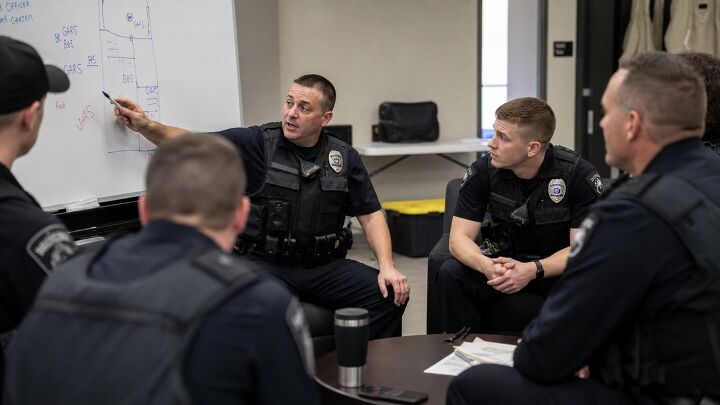
The format that produces learning has a few consistent features, and none of them are complicated. The first is a structure organized around a small set of learning questions rather than a timeline. The classic version, drawn from the military model that the AAR concept originally came from, asks what was supposed to happen, what actually happened, why there was a difference, and what should be done differently next time. That structure works because it drives the conversation toward the gap between intention and outcome, which is where the learning lives. A timeline-based format asks what happened in what order. A learning-question format asks why the outcome diverged from the plan, which is a fundamentally more useful question.
The second feature is separation of the learning review from the disciplinary and evaluative processes. Agencies that run effective AARs make an explicit and enforced distinction between the learning debrief and any performance evaluation or disciplinary inquiry. What is said in the learning review is for learning, and it does not feed the evaluation machinery. This separation is what makes candor possible, and candor is the input that learning requires. When officers know the review is a learning space, not an evidence-gathering one, they say the things that lead to improvement. When they cannot be sure, they protect themselves and the review produces nothing. Agencies that cannot or will not separate these two functions should not expect their AARs to produce learning, because the structure is working against it.
The third feature is facilitation rather than adjudication. A useful AAR is led by someone whose job is to draw out the reasoning and the lessons, not to rule on whether decisions were correct. The facilitator asks questions, keeps the conversation focused on the learning objectives, and ensures quieter participants contribute. The facilitator does not deliver verdicts. This is a learned skill, and agencies that assign AAR facilitation to whoever is available, without any development of the facilitation capability, get reviews that default to adjudication because that is the easier and more familiar mode. Good facilitation is what keeps a review in the learning register rather than sliding into evaluation.
The fourth feature is a small enough group that everyone participates. A review with twenty people in the room is a briefing, not a review. The officers directly involved, their immediate supervisor, and possibly one or two others with a specific reason to be there is the right size. Everyone in the room should be a participant, not an audience member. The larger the group, the more the dynamic shifts toward performance for the room rather than honest examination, and the less any individual feels a sense of ownership of the learning.
The Culture Conditions That Make or Break It

The “format” gets a review most of the way, but “culture” determines whether it’s real or theater. The single most important cultural condition is that leadership models fallibility. In agencies where supervisors and senior officers openly discuss their own mistakes and near-misses, the review process is allowed to be honest because the people at the top have demonstrated that admitting error is survivable and even valued. In agencies where leadership never admits error, the message to everyone below is that error is not survivable, and no amount of format engineering will produce candor in that environment. The culture is set at the top and defined by behavior, not by policy statements about a learning culture.
The second cultural condition is that lessons actually change something. Officers quickly learn whether the AAR process has any consequences. If reviews consistently identify the same problems and nothing ever changes, the process loses credibility and participation becomes rote. If a review identifies an equipment gap, a training need, or a procedural problem, and the officers see that gap addressed, the process gains credibility, and officers start bringing real observations to it because they have evidence that their observations matter. A review process that produces recommendations that go nowhere teaches officers that the review is theater, and they will treat it accordingly.
The third cultural condition is that good outcomes get reviewed too, not just bad ones.
Agencies that only convene an AAR when something went wrong have trained their officers to associate the review with blame, no matter how carefully the review is framed as a learning exercise. When reviews occur after incidents that went well, and the focus is on why they went well and what can be replicated, the review becomes a normal part of operations rather than a signal that someone is in trouble. Reviewing successes also surfaces the informal practices and adaptations that make good outcomes happen, which are frequently invisible until someone asks about them directly. A review culture that only examines failures misses half the available learning and poisons the other half with the association of blame.
The fourth cultural condition is that the process survives leadership turnover. A review culture built entirely on one commander who values it disappears when that commander leaves, unless it has been institutionalized in a way that outlasts the individual. The agencies with durable learning cultures have made the review process a structural expectation that new leadership inherits rather than a personal initiative that new leadership can quietly drop. Building that durability is harder than running good reviews, and it is what separates agencies that learn continuously from agencies that had a good run under one leader and then reverted.
The Four Questions, Spelled Out
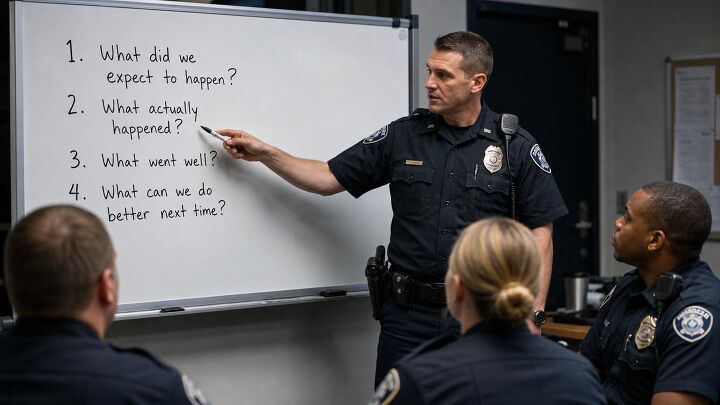
The four questions are worth stating plainly because the whole method rests on them, and they are simple enough to recall after any call.
First: what did we expect to happen? This establishes the plan or assumption the officers were operating under when they arrived, which is the baseline against which everything else is measured. If nobody can articulate what they expected, that is itself a finding, because it usually means the response was reactive rather than deliberate.
Second: what actually happened? This is the factual account, and the goal here is to get the sequence and the decisions on the table without judgment, including the uncomfortable parts. This is the step where candor matters most, because a sanitized version of what happened yields sanitized, useless learning. The facilitator’s job is to keep this honest and specific rather than letting it drift into justification.
Third: why was there a difference? This is the analytical core of the review, and it is the question most debriefs skip. The gap between what was expected and what occurred is where the learning lives, and understanding why that gap opened, whether it was information, training, equipment, communication, or a reasonable decision that simply did not work out, is what separates a review from a recap. This question is asked without blame. The point is to understand the cause, not to assign fault for the outcome.
Fourth: what do we do differently next time? This converts the analysis into something actionable, and it is the question that gives the review a reason to exist. The answer might be a change in tactics, a training need, an equipment gap to flag up the chain, or sometimes the honest conclusion that the officers did everything right and the outcome was simply outside their control. That last answer is a legitimate and valuable finding, because confirming that a decision was sound under the information available is as useful as identifying a mistake. Not every review produces a change, and a review that manufactures artificial lessons to justify itself is as broken as one that produces none.
Running One That Works at the Squad Level
Most officers reading this do not set agency policy on after-action reviews, and the good news is that the most valuable version of this process does not require agency policy. A squad-level debrief run by a first-line supervisor, or even an informal one run by the officers involved, captures most of the learning value without any institutional machinery. The supervisor who gathers the involved officers after a significant call, asks the four learning questions in a genuinely curious rather than evaluative tone, and keeps the conversation focused on what can be learned is running an effective AAR regardless of what the formal agency process does or does not require.
The keys at the squad level are the same as at the agency level, scaled down. Keep it soon after the incident. Keep the group small. Ask why, not just what. Separate the learning conversation from any evaluation, which at the squad level means the supervisor explicitly framing it as a learning discussion and then actually honoring that framing by not turning it into a performance counseling session. Make sure any lesson that requires action gets carried forward, even if that just means the supervisor flagging an equipment or training need up the chain. A first-line supervisor who does this consistently builds a squad that learns faster than the agency around it, and that learning shows up in performance.
The informal peer version is valuable, too, and entirely within the control of the officers involved. Two officers who just worked a difficult call and take ten minutes afterward to talk honestly about what happened, what they were thinking, and what they would do differently are running a micro-AAR that captures learning the formal process will never touch. This peer-level review depends entirely on the honesty of the participants and their willingness to examine their own decisions, and it is where a large share of the real learning in policing actually happens, informally and unrecorded, between officers who trust each other.
Bottom Line / What to Do Monday

- After your next significant call, run the four questions on yourself or with the officers involved: what was supposed to happen, what actually happened, why the difference, and what to do differently. Ten minutes, honest answers, no form. This is the entire core of an effective AAR, and it requires no one’s permission.
- When you participate in a formal AAR, notice whether it is asking what happened or why it happened. If it is only building a timeline, the questions that produce learning are not being asked, and you can raise the why questions yourself even if the format does not.
- Separate your own learning from your own defensiveness. The instinct in any review is to justify the decisions you made. The learning is in the honest examination of what you would do differently, which requires setting the justification instinct aside long enough to look at the decision clearly. This is a discipline you can practice regardless of how your agency runs reviews.
- Review the calls that went well, not just the ones that went badly. Ask why they went well. The practices that produce good outcomes are frequently invisible until you examine them deliberately, and they are more replicable than you would expect once you can name them.
- FTOs: model the after-action review as a normal, low-stakes part of the job from day one. A new officer who learns early that reviewing a call honestly is standard practice, not a sign of trouble, carries that habit through their career. The framing you establish in the FTO period is the framing they will default to for years.
- Supervisors: run short learning debriefs after significant calls and honor the learning framing by keeping evaluation out of them. If you mix the learning review and the performance counseling, you lose the candor that makes the review worth running. Pick one function per conversation and be clear which one it is.
- Supervisors and command: track whether AAR-identified problems actually get addressed. A review process that repeatedly surfaces the same issues without resolution teaches officers that the process is theater. Closing the loop on even a few identified problems does more for review credibility than any amount of process refinement.
- Fire/EMS: the post-incident debrief tradition is stronger in the fire service than in law enforcement, but the same failure modes apply, especially the drift toward evaluation and the tendency to review only calls that went wrong. The tactical debrief after a working fire or a significant medical call has the same requirements: it must be soon, small, focused on why, and separate from evaluation.
That’s Front Line Friday for this week: the after-action review is one of the highest-leverage learning tools available to any agency, and most agencies waste it by running a documentation exercise instead of a learning conversation. The fix is not more time or more forms. It is asking why rather than what, keeping the group small and the timing tight, separating learning from evaluation, and building a culture where honest examination is safe. Most of that is within reach of a single first-line supervisor without any policy change at all. Next week we are on off-duty carry considerations, covering the practical, legal, and tactical factors that separate a workable off-duty carry setup from one that looks good in the store and fails in practice.