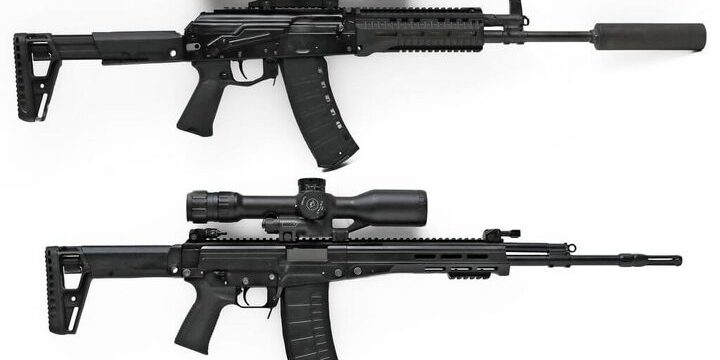

A recent development unveiled by Kalashnikov.ru was the Kalashnikov Concern’s “AK-12 Plus,” a revealing example of how Russian ambitions to increase the effective range of their current assault rifle designs are driven by a realization of the need for improved accuracy and increased range without changing to a larger caliber quite yet. Presented as a “Plus” configuration package, the concept was intended to turn the standard AK-12 into something far more specialized than a conventional infantry rifle. Yuri Trutnev, the deputy prime minister of the russian federation, requested this program.
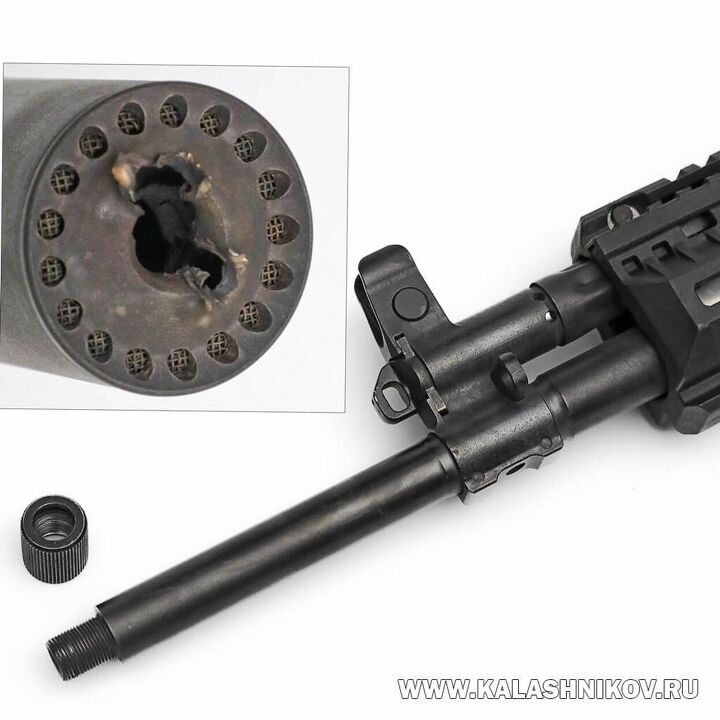
In its proposed form, the AK-12 Plus is expected to be equipped with a thermal imaging and optical sight to improve day and night operations, issued with six magazines, and a direct-thread suppressor. It also differed from the base AK-12 in several respects: a heavier-profile barrel, a threaded muzzle without the usual flash hider or compensator, an extended AK-308 handguard, and Russian-legacy AK-style leaf rear sights similar to those on the RPK-16.
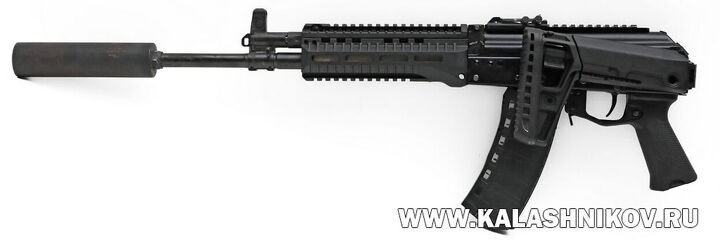
At first glance, this may seem like a simple modernization package. In practice, it represented an attempt to stretch the role of an assault rifle into territory usually occupied by a designated marksmanship rifle. The AK-12 Plus concept was introduced with a bold goal: to hit a head-sized target at 500 meters using a 5.45x39mm rifle. In effect, the AK-12 Plus was intended to serve as an improvised designated marksmanship rifle while remaining chambered for the legacy intermediate 5.45 cartridge. 30cm at 500m would give the rifle roughly a 2 MOA group.
That idea is not new; for decades, designers have improved the accuracy of assault rifles simply by adding optics and refining the barrel. Better sights do help with aiming, and a heavier barrel can improve accuracy by stiffening the barrel harmonics. But the main limitation is not the rifle alone; it is the cartridge and the shooter. The 5.45x39mm round is an intermediate cartridge designed for controllable fire and effective combat at typical infantry distances. At 500 meters, its retained energy drops sharply, and wind drift becomes a major problem. Even a moderate
crosswind can push the bullet far enough to make precise hits on a small target difficult. The 5.45 has the potential to be a very accurate cartridge, but lacks mass and kinetic energy.
The AK-12 Plus is seen less as a replacement for a sniper rifle or designated marksmen rifle and more as an experiment in pushing an assault rifle to the edge of its practical capabilities. The included optical sight undoubtedly improves aiming, but that advantage matters most in the hands of a highly skilled marksman. A standard rifleman, especially one firing from unstable positions in combat, will not transform an assault rifle into a designated marksman rifle simply by adding optics, but it does help. Accuracy still depends on shooter skill, ammunition quality, weather, and the platform’s limitations. So one would expect an improved marksmanship training program to follow.
The discussion also points toward future systems such as a compact “Mini-SVCh,” potentially chambered in 5.45x39mm or another flavor. Because the SVCh platform was designed as a sniper rifle rather than an assault rifle, it may be better suited to extracting the maximum possible accuracy from such ammunition. High-quality rounds like the 7N40, which reportedly have shown impressive performance in standard AK-12 rifles, would likely benefit even more from a purpose-built precision platform. Another avenue to cover is the heavier barrel. Though using AP reduces the barrel life to roughly 5,000 rounds of the AK-12.
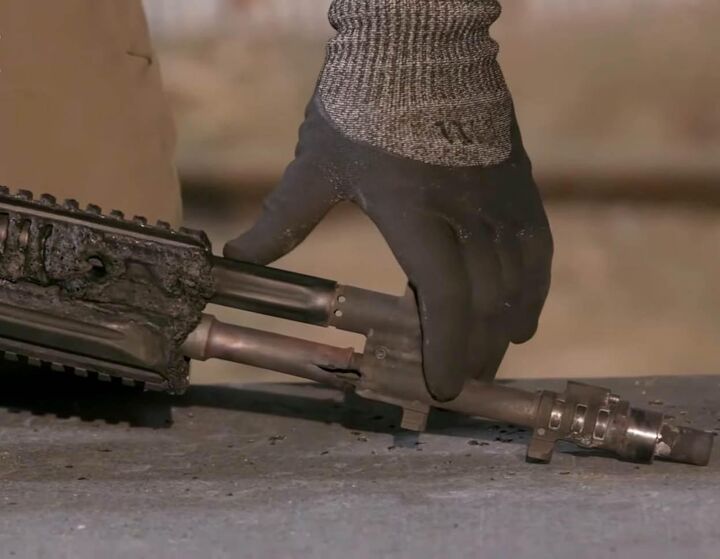
The AK-12 Plus addressed a failure point on the original AK-12 barrel, which was revealed during torture test, showing a weak point under the sling loop with a 90-degree shoulder, causing the barrel to burst during the test. The AK-12 Plus uses radius steps on the barrel journals, and the gas block also features a new relocated sling loop. This would also improve the barrel life for automatic rifle use if it is pushed in that role.
Ultimately, the AK-12 Plus is best understood as a useful experiment rather than a final solution, as we most likely will see some of these new features in their future assault rifle design. It shows both the flexibility of the Kalashnikov platform and industry and the limits of trying to make a single weapon serve two very different roles. The concept may see limited use in specialized units. Still, its greater value lies in demonstrating how far an AK rifle can be pushed before further modernization becomes the better answer.