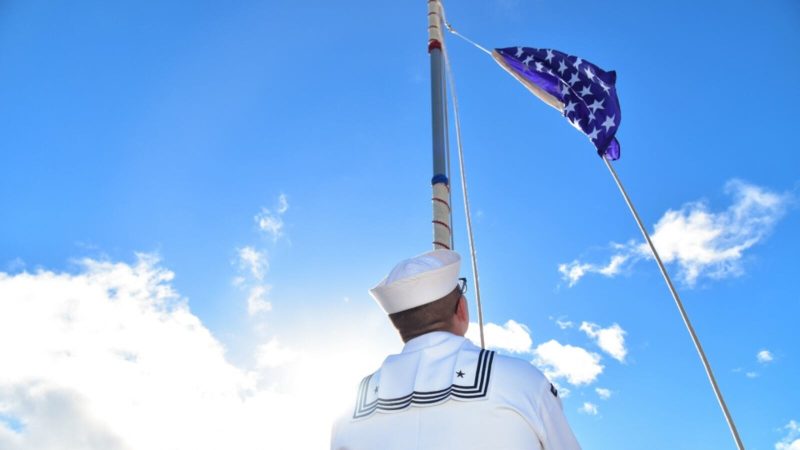
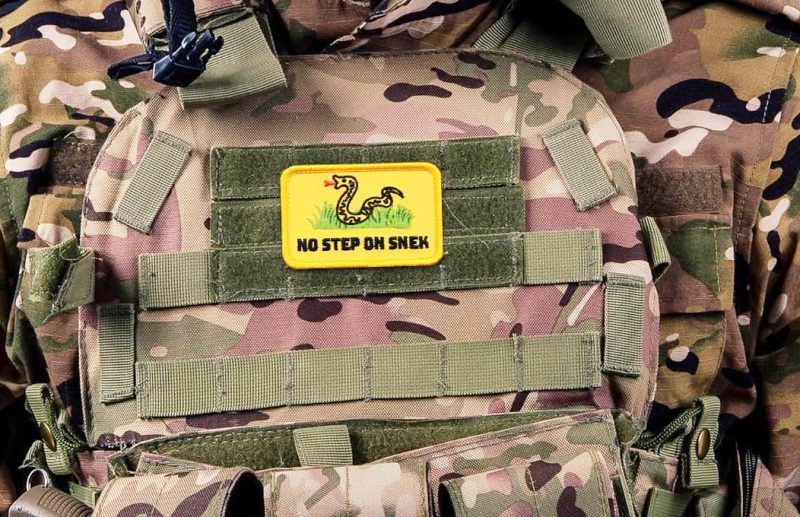
Has anyone ever told you, “No Step on Snek?” Probably not. But you may have seen it online, on a morale patch or a flag or a shirt, and wondered what it means. If you thought it was a dumbed-down version of the American Revolution’s Gadsden Flag, you’re right. Even more so if you’re seeing a “Don’t step on snek” variant.
Estimated reading time: 9 minutes
The origins of both versions are clouded in a political, social media, and pop culture haze, with different theories about where it came from and even what it actually means. We did some digging and uncovered a muddied narrative that explains at least part of this elusive phrase, its meaning, and its proper usage, which depends on your views and situation. Told you it was muddy.
So, read on. And watch where you step.
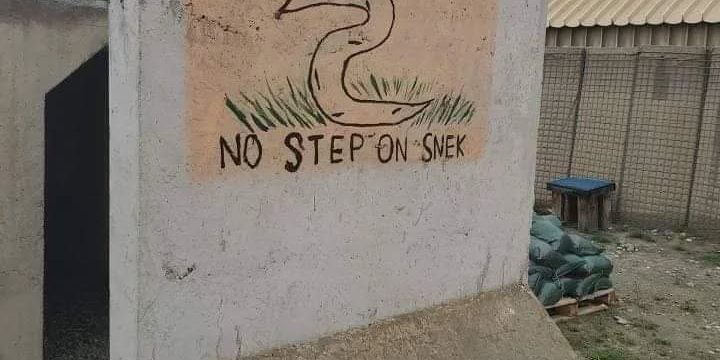
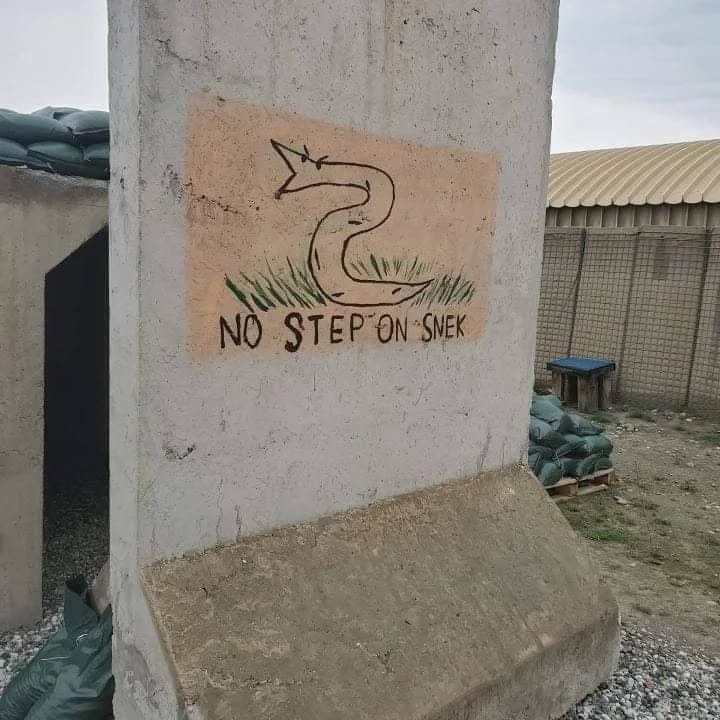
According to the IG account @warmurals, this No Step on Snek graffiti was photographed at Tactical Base Gamberi (a “dusty outpost in Laghman province near the fabled city of Jalalabad) in March 2020. This article originally ran in May of 2024.
Early Origins
No Step on Snek is a relatively new phenomenon, but its roots go back to before the French & Indian War, which was the North American component of the wider Seven Years War between Great Britain, France, and their respective allies. Historians date the war from 1756 to 1763, but trouble was brewing for several years before that.
Competing claims to the land west of the Allegheny Mountains caused friction between British and French colonists, the latter of whom had ascended the St. Lawrence River, into the Great Lakes region, and south to the Ohio and Mississippi Valleys. The American colonies, though ruled by Great Britain, were split on whether to fight the French settlers over what some saw as an encroachment on American claims.
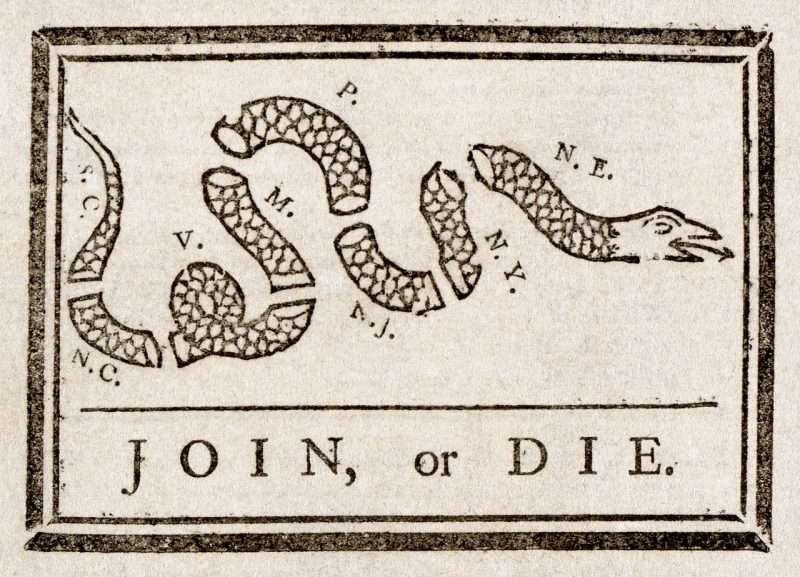
Benjamin Franklin’s original Join or Die woodcut first appeared in the May 9, 1754, edition of The Pennsylvania Gazette. This is where the no step on snek flag (and meaning) originally descends from. (Public Domain)
Responding to colonial disunity, Benjamin Franklin published the first American political cartoon on May 9, 1754. It was a woodcut of a severed rattlesnake, titled Join or Die. Each segment was labeled as a different American colony, with New England as the head. Delaware was not represented because it didn’t yet exist, and Franklin inexplicably left Georgia out altogether.
Franklin’s point was that the colonies must unite against a common enemy. Being a worldly man, Franklin understood that the looming war would be much more than a provincial border dispute. In fact, many historians see the Seven Years War as the first true World War. The North American part was a sideshow, but it was deadly serious to the participants.
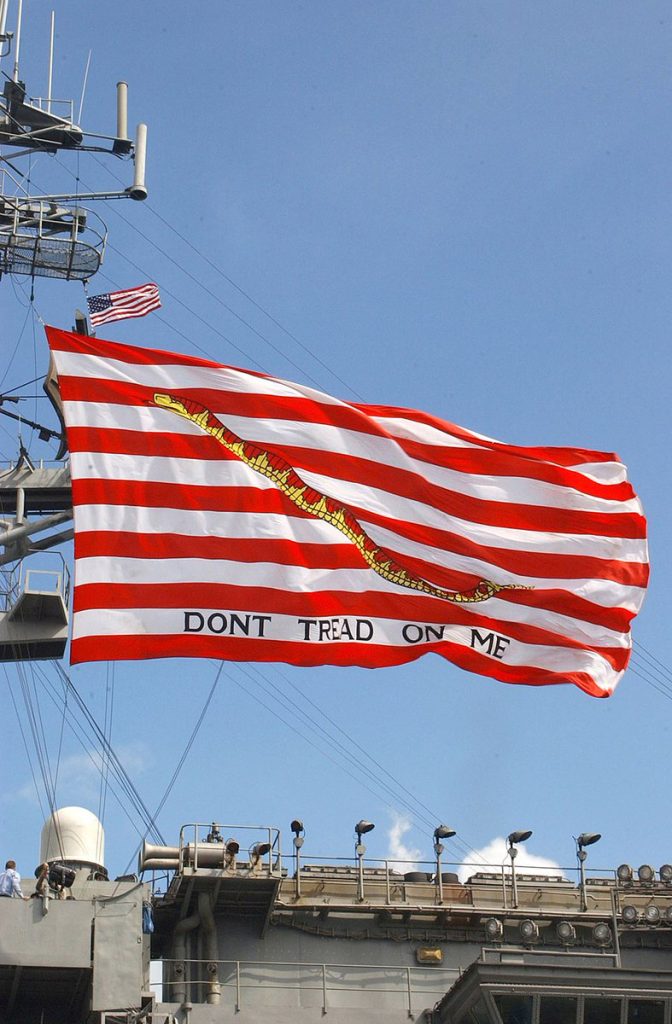
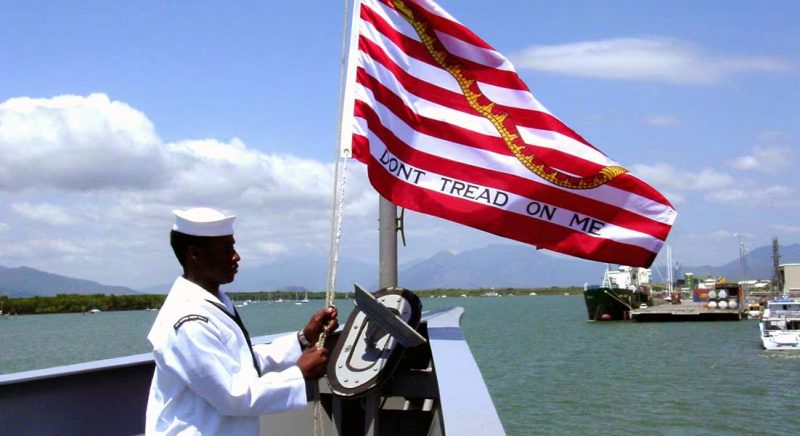
The First Navy Jack, seen displayed above on the USS Blue Ridge (LCC-19) may only be flown by the oldest serving warship in the fleet, barring the USS Constitution. Blue Ridge is currently the flagship of American’s Seventh Fleet, based out of Yokosuka, Japan. Other naval vessels are periodically authorized to the display the blue Navy Union Jack, which is a different beanner. As you can see, the Navy Jacks, too, are related to the current No Step on Snek flag.The blue US Navy “Union Jack” is not one of the No Step on Snek flag predecessors. The Union Jack and its 50-star field is flown above all anchored USN ships in port, with the exception of the oldest serving commissioned warshipo in the fleet.
Franklin and others recognized that French colonies to their west would always threaten the British colonies, especially given time to expand and increase their strength. Better to fight them when they were relatively weak, and their parent country was embroiled in a much wider war.
Join or Die was the first of a long series of American symbols using the rattlesnake. Franklin himself admired the rattlesnake, which he thought a good representation of American values, writing in 1775 that,
“…she has no eye-lids. She may therefore be esteemed an emblem of vigilance. She never begins an attack, nor, once engaged, ever surrenders…’Tis curious and amazing to observe how distinct and independent of each other the rattles of this animal are, and yet how firmly they are united together, so as never to be separated but by breaking them to pieces.”
Christopher Gadsden’s Flag
That Franklin wrote those lines in 1775, the year the American Revolution went hot, is no coincidence. Franklin, once again, was using the rattlesnake to rally American unity against Great Britain. Those words inspired a South Carolina Congressional delegate named Christopher Gadsden, bringing us closer to the modern No Step on Snek.
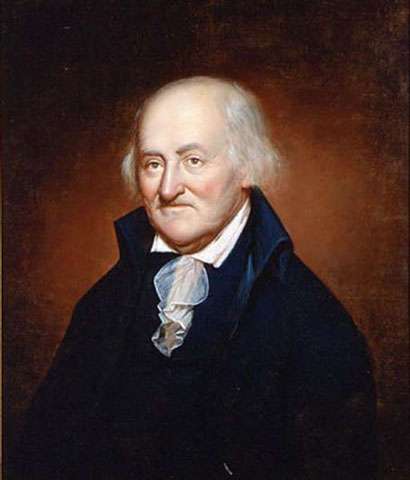
Christopher Gadsden made his the primary inspiration for the no step on snek flag (though that was long before the meme of course) for Commodore Esek Hopkins, the first Commander of the Continental Navy. Painting by Charles Fraser. (Public Domain)
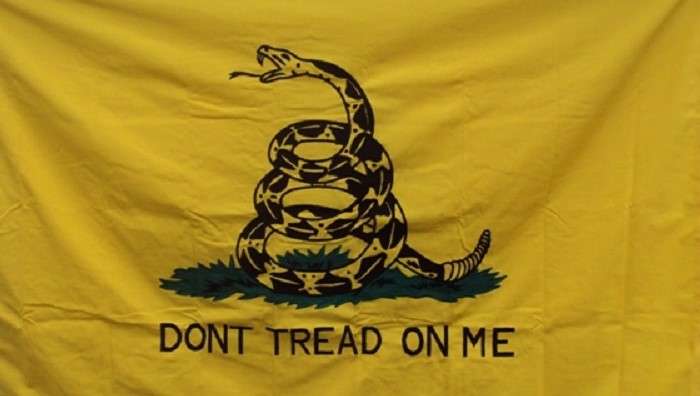
Dont Tread on Me
Christopher Gadsen created the flag in 1775 for Commodore Esek Hopkins, who hoisted it on his flagship, the USS Alfred. Esek was named the Continental Navy’s first Commander-in-Chief two days later. The Continental Marines flew a similar flag early in the war.
This is the original Gadsden banner from whence the sno step on snek flag is derived.
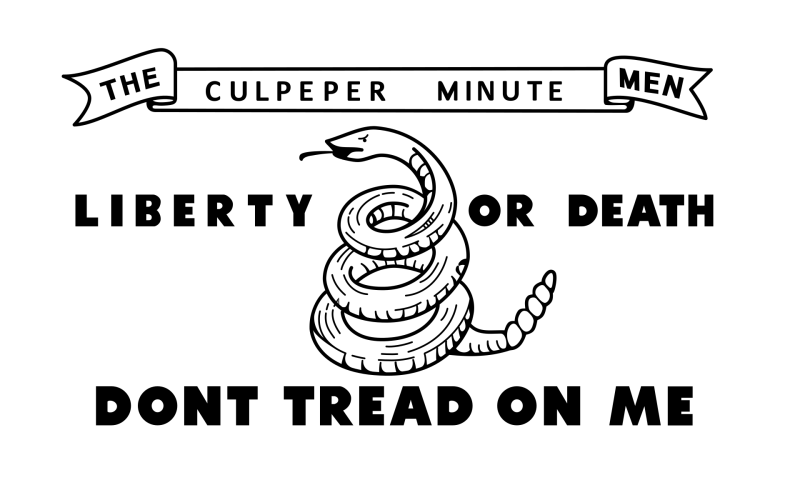
Gadsden, like Franklin, meant for his flag to warn Great Britain against violating the American colonists’ liberties. The flag also represented vigilance and was possibly the American Revolution’s most enduring symbol. The original flag lacked an apostrophe in the word “Dont,” though some later versions included it. Gadsden Flag variations appeared as the first American Navy Jack and on several Minutemen company flags, including Virginia’s Culpeper Minutemen, formed in 1775.
The First Navy Jack, with it’s Don’t Tread On Me message, is flown by the oldest commissioned warship in the U.S. Navy operational fleet. It and the Blue Navy “Union” Jack are traditionally flown from “jackstaffs” (small flagpoles) at the bow of Navy vessels that are in port or at anchor. The First Navy Jack was actually flown on all Navy ships during the majority of the GWOT era, but on June 4, 2019 (the 77th anniversary of the Battle of Midway), the tradition resumed. USS Blue Ridge (LCC-19) returned to the sole honor of being the only warship authorized to fly the First Navy Jack. All other ships in the fleet returned to using the Blue Navy Jack. (Navy Jack in photo above by Signalman 3rd Class Sean Polidore aboard the USS George Philip (FFG-12). (US Navy photo, Chief Hospital Corpsman Gary Mihalko.)
No Step on Snek
You can probably see where this is going by now. Later generations inevitably have their own take on historical objects and phrases. Social media has accelerated those trends. Urban Dictionary and Reddit are often indispensable resources when trying to navigate online slang. No Step on Snek is pretty obvious, especially when you look at the artistic renditions accompanying the phrase itself.
The military’s use of No Step on Snek is apparent. (as you can saw with our featured imagage above via “Untied Status Marin Crops” Instagram); you can see other versions on the Know Your Meme website.
The simplistic language is usually paired with rudimentary drawings of a snake on a yellow field. Many examples look like they were drawn by children. But No Step on Snek is very deliberate. It’s a reductionist take on a classic symbol, often meant to be humorous, though the verbal or textual versions can be more practical. Someone up in your business? You might tell them “No Step on Snek.” Or you might not, considering it’s an uncommon saying for a niche crowd. But it does happen. More likely, you’ll use it in social media interactions when someone is ragging you. Either way, it means “back off.”
Who Started No Step on Snek?
Well, that’s difficult to pinpoint. Some say it comes from the Gadsden Flag’s emergence among right-wing political movements like the Tea Party. Left-wing opponents supposedly started saying “No Step on Snek,” accompanied by the simplistic drawings, to imply that those folks were stupid. I’ve seen it used that way, along with other symbols and sayings. Political opponents on both sides love co-opting and lampooning each other’s imagery.
I also tracked No Step on Snek to a seemingly abandoned Instagram account called “Untied Status Marin Crops.” Yes, you read that correctly. The page looks like it was run by a serviceman, and it made fun of military life through wickedly sharp memes, often with deliberately misspelled verbiage. No Step on Snek flags are featured prominently. It looks like many photos were submitted by servicemen stationed all over the world, including their own versions of the flag.
Those appear to be the two most likely origin points for No Step on Snek, though I couldn’t say which came first. I think it’s unlikely, however, that they did it independently of one another. Either way, pop culture absorbed the phrase through osmosis.
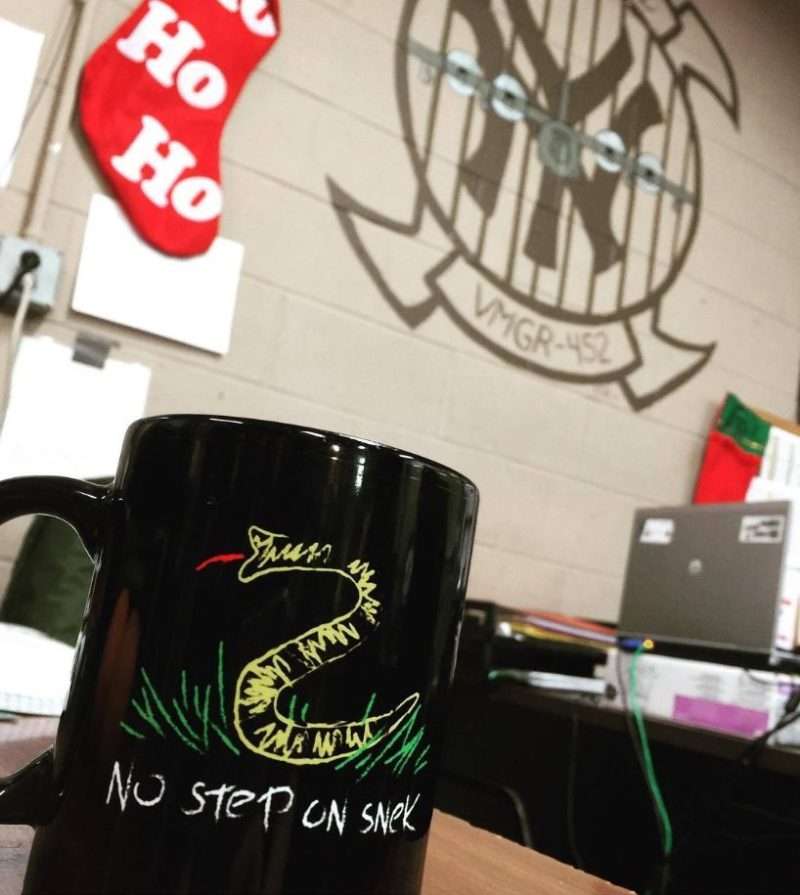
Of course, it’s on a coffee mug. It’s on apparel, too. Seems like there’s as much demand for a No Step on Snek shirt as there is for a traditional Gadsden Flag Shirt.
I’ve also seen other adaptations, including a t-shirt I bought saying “Step on Snek and Find Out.” Curiously, the reactions I’ve gotten to the shirt bear out the two origin theories. I’ve had military guys laugh at it, clearly associating it with the Gadsden Flag’s original meaning. But my decidedly left-wing son-in-law laughed because he associated it with insulting right-wingers. He even expressed surprise that I, an avowed right-winger, would wear it. We both found it amusing.
Take it How You Want
No Step on Snek speaks to different people in different ways. Good symbols, or phrases, often do that. Want to tell people to back off? No Step on Snek. Looking for a modern form of a patriotic theme? No Step on Snek. Feel the need to insult right-leaning political opponents? You get the point. No Step on Snek works because it appeals to modern sensibilities that often think in “text speak” like LOL, OMG, and probably many others I have no clue about. There are actually several discussion threads out there addressing these varied interpretations (like this one on Reddit).
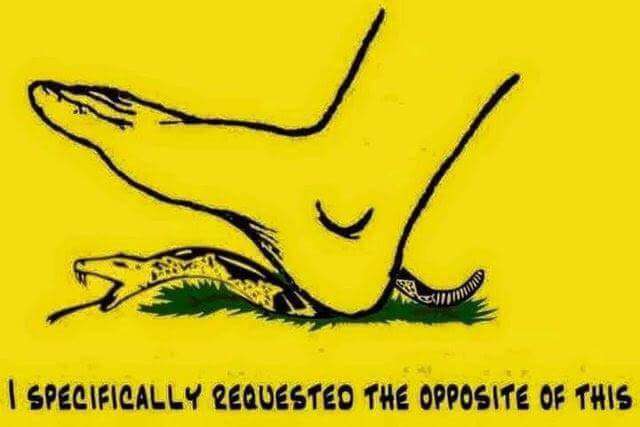
Another clever variant. (via @marincrops on Instagram)
But the trend speaks to the original rendition’s powerful symbolism. Franklin and Gadsden understood that power and its effect on their target audience, whether public or military. No Step on Snek does the same. It’s just updated for the Social Media crowd. You may find it stupid. You may find it edgy. Or maybe it’s just funny. But I’ll wager that you instinctively get it, no matter how it’s used.
Enduring symbols are like that.
No Step on Snek speaks to different people in different ways. Good symbols often do that, especially when descended from the Gadsden Flag. It’s almost an earlier version of today’s FAFO.
This site is an independent labor of love run largely by people like you (well, if you’re reading this). Help us keep the lights on. Use one of our links to buy your loot and plunder.
⚠️ This article may contain affiliate links. If you make a purchase using such a link, we will earn a small commission from that sale at no additional cost to you.